Showing posts with label winter. Show all posts

Tuesday, 24 December 2013

Panettone and Hidden Chocolate Bread & Butter Pudding

Christmas time yields countless gifts, not least of which is the flurry of foods you only end up eating at this time of year. Like memories of ripe fruit from childhood, the recollection of these festive flavours is preserved in semi-perfection over the intervening year due to their short window of consumption. Like the Christmas tunes flooding the airwaves from the beginning of the month, they are welcomed in our house with open arms… (Though after a few weeks of these, you are happy to wave them off again.) Mince pies, pigs in blankets, turkey and stuffing, Christmas pud, Kirsty McColl & The Pogues… I love them all.*

In my perfect gingerbread house, the super-soft pillows would be made of rich, aromatic panettone. Light, buttery and filled with candied peel and dried fruit, choirs of (Italian) Christmas angels might have conceived this celestial sponge. A Christmas hit in our house, the BSG and I love it with Nutella for breakfast, a hot drink at teatime or a glass of sweet liqueur later. Quite frankly, it doesn’t stand a chance of lasting more than a few days. Should hell freeze over and stale leftovers remain once Christmas is over (fresh works too in case you can’t wait), then it makes the best bread and butter pudding out – a sneaky one to slip in just before any January detoxing…

For extra festive, sprinkle with icing sugar before serving and lace the layers with a few shakes of Gran Marnier for grown-ups.

Merry Christmas!


pud2


You need (Serves 2)


2 small round ovenproof dishes of ramekins, buttered

A couple of slices of panettone (whatever you have left, cut into rounds)

A few squares of good dark chocolate.  Green & Black’s Maya Gold works.

1 egg

160 ml whole milk

1 tablespoon caster sugar

1/2 teaspoon vanilla extract

Grand Marnier (optional)


Preheat the oven to 160C. Lay your panettone pieces in the buttered dishes and tuck a couple of squares of chocolate in amongst the layers. Beat the egg and other ingredients together in a bowl and pour evenly over the bread so it comes up the sides. Sprinkle the tops with brown granulated sugar if you like, for a little extra crunch. Put a dish on the oven shelf, with the 2 ramekins inside it and carefully pour boiling water into the larger dish so it comes at least halfway up their sides. Bake for 20-25 minutes until just set.

Serve with creme fraiche or yogurt to cut through the richness, with the essential Christmas clementine on the side.

[ud3photo1

*Give amazing little sprouts a chance: they’re not just for Christmas, but for the whole winter.

Thursday, 28 November 2013

Pot-roast pheasant with butternut squash, Savoy cabbage and onion

The BSG is a game lover. However, after a bad experience with a sinewy, over-exercised rabbit we picked up in Lincoln a few years back, I haven’t been able to separate that gamey taste from a tough-as-old-boots food memory, so I’ve shied away from it somewhat.  So the prospect of three pheasants in our fridge, ready for the eating, filled me with dread. They say you must face your fears, so I thought I’d tackle mine head on…

When I asked the BSG what to do with it earlier that day, I received a very casual one line email: just bung it in a pot with the veg we’ve got left in the bowl and some stock and wine and cook for about 45 minutes. Easy.

OK, I thought, I can do casual, even though all I could think about was overcooking the damn thing, its stringy carcass languishing in thin, insipid juices. I made sure we had emergency freezer supplies, just in case…

But actually, what resulted was really rather good – helped by a pleasantly mild-tasting bird – and I’ll be doing it again. Not to mention easy; the very definition of a one-pot wonder. Two of us ate well, so figure that this recipe would serve three… It is easily multiplied, but increase the cooking times.

pheasant


You need:

1 onion, roughly chopped

2 bay leaves

3 juniper berries

1 large glass red wine

1/2 pint of stock

1 whole pheasant

1 clove of garlic, crushed

1/2 a butternut squash, deseeded, peeled and chopped into 1 inch pieces

1/4 savoy cabbage, sliced

a lump of beurre manié: half softened butter and plain flour (optional – or add flour to the onions at the beginning)


Preheat the oven to 190 degrees.

In a heavy based lidded pan, sweat the onions in a little oil over a medium heat until they start to colour. Add the bay leaves and juniper berries – plus a tablespoon or two of plain flour if you want to thicken the sauce.

Deglaze the pan with the red wine and add the stock. Sit the pheasant in the pan amongst the onions, add the butternut squash pieces, garlic and season. Put the lid on the pan (I added a foil cartouche as well because I thought I ought to but I’m not ever really sure what this does. It just felt right).

Put into the oven for 45 minutes or so, turning the bird over halfway through (again – this just feels proper as I always do it with my roast chicken to keep the breast moist).

Remove the pot from the oven. Check the bird is cooked then rest it on a board and take out the squash from the pan whilst you reduce the sauce over a good heat – here you can whisk in the beurre manié to thicken if you like. Season to taste. Return the squash to the pan and add the cabbage. Put the lid on the pan and let this all cook for a further 7 minutes.

Carve the pheasant breast, joint the legs and serve in a bowl on top of the vegetables with plenty of sauce poured over, like a stewy soup (yes, you’ll need a spoon too).

For extra pleasure, I recommend mashing the squash into the gravy with the back of your fork. Watch out for lead shot – it’s in there somewhere and your molars will thank you for it.

Game on…

Friday, 22 March 2013

Ratty Spanish Eggs

Ratty Baked Eggs

A couple of months back, I had breakfast at Providores on Marylebone High Street with my friend Esther, she of the highly-addictive Recipe Rifle. Spurred on by her advice (I wasn’t going to argue with a pregnant lady) and a few reviews I’d read, I plumped for a cortado – my new favourite coffee – and Turkish eggs, baked in spicy tomatoes and swimming under hot chilli butter and yogurt. They were utterly delicious and if you’re a fan of soldier-style dipping I urge you to go along and try them.

Crawling my way over the threshold after a rare hour in the gym yesterday lunchtime I was famished, yet devoid of inspiration. Honestly, I would have just eaten four pieces of toast if I’d been really stuck... However, with one egg left in the carton and a bowl of leftover ratatouille to finish off I decided to put them together.

This is more a formula than a recipe could be applied to various mushes; stews, bolognaise sauces, curries etc. Just dollop a couple of spoonfuls of whatever’s left over into an ovenproof pot or ramekin, make a comfortable nook for the egg in the middle with the back of a spoon and crack the egg into it. Drizzle over a little oil and a spice of choice – here it was paprika as I was feeling a little Spanish (Madonna’s La Isla Bonita happened to be playing on the radio). Oh, and some scrapings of a heel of Grana Padano before baking it at about 190C for 12-15 minutes or golden and slightly inflated on the top.

I ate mine with toasted wholemeal pitta, sliced into soldiers - or rather, soldados - to dip. Rather a smug working-from-home lunch I thought, when it could have so easily been Heinz Cream of Tomato...

Wednesday, 6 March 2013

The River Café

The BSG and I managed to sneak our way into the perennially popular River Café on the first sunny day of spring, thanks to an amazing winter lunch offer (on ‘til 22nd March, if you’re asking). We’d mused over a visit for some time, but couldn’t quite swallow the prices. However, this deal and the fact that it was my birthday seemed the perfect opportunity to sample for ourselves the much-vaunted seasonal ingredients, painstakingly sourced and treated with simplicity and respect. Not bad for a place that started out as a staff canteen for Richard Rogers’ firm of architects next door. Lucky them.

Its list of cheffy alumni that have worked under co-founders and superwomen Ruth Rogers and Rose Gray has clout to equal that Cambridge-footlight dream class of Thompson, Fry and Laurie: Jamie Oliver, Hugh Fearnley-Whittingstall, Stevie Parle, April Bloomfield, Theo Randall, Sam and Samantha Clark (and many others), so we both conducted a mental audit of the cast working smoothly and diligently behind the very visible pass. If this was a school it’d be out of the league tables - no doubt many of the current crop will go on to be stars as well.

Cooking in full view – YIKES.. I’d certainly have dropped something. If nerves ever jangled or tempers rose, they didn’t show. In fact, you could almost smell the quiet authority that extended to each plate smoothly winging its way out to the tables. Everyone was busy doing their own thing on this tight ship – the BSG and I supposed that someone was in charge of pasta, another veg, fish and so on. The friendly waiting staff pepetrated this feeling of zen, were relaxed and efficient and ever so slightly über-cool…though of course they all made that look effortless too.

The day was utterly perfect, especially considering it was a Monday; the warmth of spring sunshine on our backs a foil to the chilly breeze that blew off the river. Once we got inside, lemony light spilled through the large windows across our table; cue Prosecco with fresh blood orange to wet our whistles. What followed a basket of bread and gorgeous, grassy olive oil was a series of perfectly simple dishes; including fennel salami and chicken-liver crostini, a plethora of exciting leaves we’d never heard of, fresh sardines, gum-bubble thin filled ravioli (the best pasta I have EVER eaten), sweet scallops with Castelluccio lentils , slow-cooked fennel and monkfish with salsa verde. A lot, you may think – and you’re probably right – but for some reason it felt light and healthy due to the freshness of the flavours (until we got to the lemon tart and polenta cake, that is). It was beautifully simple: there were no ground-breaking cooking techniques to distract from the food, so it was just as well that the headliner ingredients were on form.

This restaurant is a classic, an institution, a favourite - exactly what a dream canteen at work would be like (albeit work would have to be a merchant bank). Like the Rolling Stones live in concert - rather than a 2-hour late, squeaky Justin Bieber surrounded by gyrating backing dancers and tedious smoke effects - it continues to stand the test of time, taste and wallet. In short, it could prove ruinous come April and we don’t give a damn if it’s AT ALL trendy, but the BSG may well make The River Cafe a habit. Once a year. If we save.

Spring has sprung. Yippeee.

IMG00594-20130304-1305IMG00593-20130304-1305
IMG00595-20130304-1319IMG00598-20130304-1339
IMG00600-20130304-1403IMG00601-20130304-1403


Friday, 25 January 2013

A bread and butter pudding for the snow

Bread and butter: so simple, yet the stuff of childish dreams. As delicious-sounding in literature as any cake - especially when drawn from a wicker luncheon basket and laid out on a cloth with jam, or cold chicken and roast beef. Milly Molly Mandy and Billy Blunt gobbled all theirs up on their fishing excursion and it’s little wonder – all someone has to do is say those three words together and I am thinking of teatime (and forever of Grandpa, lord of the tea table with his packet of plain chocolate digestives – neatly secured each day with an elastic band).

Clearly, bread and butter pudding has less to do with butter than it does with bread (not to mention the eggs, sugar and milk) but the very fact that those two happily-wed words are in the recipe makes it a winner in my eyes. Last September on the eve of a friend’s wedding I was lucky enough to be party to his pre-wedding family dinner and thereby to the most fantasmical (that’s fantastic with an extra O) pudding. Although the portion control didn’t exist and my bowlful could have felled an adolescent elephant I nobly ate my way through, amongst the dairy every which way, a warm wedge of white chocolate and whisky bread & butter pudding. INCREDIBLE.

After a long walk on Saturday, or feet crumping through the fresh snow making dreams of mountain adventures, we felt we deserved a treat. This pudding, crisp on top and snowy light within was perfect foil to the conditions. It’s adapted from a recipe that uses croissants (which may be amazing – but I felt somewhat superfluous. After all, we’re supposed to be on some sort of regime until February)… I went in heavier on the whisky – on a medicinal bent you understand  -  yet lighter on the sugar, as we were all chilled to our cores and because white chocolate is sweet enough, thank you.

This is dedicated to my dear, pudding-partial Grandpa. He would have loved it, crowned with plenty of cream. He might have even had a second helping too.


Whisky and White Chocolate Bread & Butter Pudding

500ml milk
500ml double cream
A few drops of vanilla essence
3 eggs
5 egg yolks
150g caster sugar
8-10 slices of white bread, crusts removed and cut in half into triangles
25g sultanas
25g butter, melted
175g white chocolate, smashed into little pieces in its wrapper
4 tablespoons whisky
55g  marmalade (didn’t have apricot jam, but the extra orange taste is a winner)
icing sugar, to dust

Method

Preheat the oven to 200C/400F/Gas 6.

Pour the milk and cream into a pan, add the vanilla essence and bring slowly to the boil.
Crack the eggs into a mixing bowl with the egg yolks and sugar and beat together until pale and fluffy. This bit is actually quite important as your pudding will be light rather than stodgy.
Lay the bread over the base of an oblong ovenproof dish, slightly overlapping each piece. Sprinkle with the sultanas and pour over the melted butter.
When the cream mixture has reached boiling point, take it off the heat and allow it to cool slightly. Add the egg mixture and white chocolate to the cream and stir well. Leave for a few minutes to let the chocolate melt, stirring occasionally.
Add the whisky to the cream mixture and strain it all through a sieve over the bread. Let the bread soak it all up nicely, before covering the dish with foil.
Bake in the oven for 25-35 minutes, or until almost set.
Remove from the oven, coat the top with the marmalade and dust with icing sugar. Either brown the top with a cheffy blowtorch or place under a grill or into a hot oven for a few minutes before serving. Wait if you have to - it must be warm, not hot.

bread and butter pudding

Monday, 7 January 2013

Come Back Chicken and a Big Apple

As food goes, there’s nothing more homely than roast chicken. It was the first thing we cooked in the box-fresh oven in the new kitchen and the last thing we laid on for my sister and brother-in-law last Friday night, hours before they jetted off to a new chapter in New York. I had been desperately flicking though my mental rolodex of ways to make them stay and failing that, I settled on a dish that might remind them to return home one day…

We managed to cram in a decent enough amount of wine as well – not so much that it got too emotional – plus some passion fruit creams in little espresso cups from my Christmas copy of Kitchen Diaries II, speckled with the seeds and soaked in a pool of golden juice, which accompanied my teaspoon with every mouthful, right to the bottom.  Once blasted Banuary is over, I am going to give it a bash with other fruit as it was particularly delicious and super easy.

Passion fruit creams

What’s below is NOT rocket science obviously but how I do my roast chicken which, the BSG tells me, is pretty good. The basic formula will take on almost anything throughout the year; fresh herbs such as sage or tarragon, or wild garlic in the cavity, spices like Ras-el Hanout or Harissa and yoghurt rubbed into the skin and sit proudly alongside any salad as well as lasting you through the week. Good for the diet and the budget: what better friend could you ask for right now?

Basic Roast Chicken

You need:
1 chicken (free-range. One of those happy Woodland-roaming ones will do – not sure of the weight but should cost you between 6 and 8 pounds)
1/4 lemon
½ onion
Fresh thyme sprigs (optional)
Olive oil/butter
Salt & pepper

Remove the chicken from the fridge 10 minutes before you need it to bring it to room temperature and then place it in a roasting pan. Heat your oven to 190C. Slice the top quarter off a lemon and squeeze it over the top of the chicken before putting it into the cavity with the thyme sprigs and the half-onion. Drizzle the top and legs with oil or smear with a few knobs of butter. Season generously with salt and lightly with pepper before putting into the hot oven.

Cook for 20 minutes, before taking the tray out and turning the chicken over breast-side down (be careful here!). This should do some basting for you and ensure that everything is as juicy as possible. Return to the oven and cook for another 20 minutes before turning the chicken back over, spooning some of the basting juices over the legs. The onion, lemon or thyme may fall out at this stage, but they will go towards making lip-smacking gravy as they cook away in the tin. The skin should crisp up and brown in this last 20-30 minutes.

After between an hour and 5 minutes and an hour and a quarter’s cooking time, the chicken should be done, but to double check, insert a skewer between the leg and the breast to see if the juices run clear. It is almost always an hour and 10 minutes for me, but ovens vary. Lift the bird out and set onto a board, covering with foil if you like. It does well to rest for 10 minutes while you make the gravy; it will be juicy and easier to carve after resting.

For the gravy: drain off as much of the clear fat from the tin as you can, squeeze the remnants of the lemon quarter with the back of a spoon and keep any bits from the onion in there which have caramelised but not burnt, discarding the rest. Put the tin over a medium heat and scrape the sticky brown bits loose – they will be packing valuable chickeny flavour. Add a knob of butter and melt it. You can add a tablespoon of plain flour at this stage and cook it lightly, for thicker gravy. Add some hot or boiling water – about an espresso-cup’s worth – and a slug of white wine, smear it all together and simmer for a few minutes. Taste, adding more water and seasoning if necessary.

Wednesday, 19 December 2012

Frangipane-topped mince pies

I love mince pies and so, it transpired this week , does my one-year old nephew George. I am not surprised; this child was born to be a gourmand. He sports round, rosy cheeks and enjoys a polo-neck most days, pootling around somewhat unsteadily on his feet; channelling the Eighties food-critic vibe perfectly.

Although we share the mince-pie love, Master G and I approach them in different ways; I like mine warm (if the mincemeat even makes it out of the jar uneaten) whereas he enjoys rubbing the pie between his hands to extract the currants before plucking them out daintily (an amuse-bouche, if you will) and poking the lot in the general direction of his mouth. Either way, we all agree that a baby that smells of mincemeat at Christmas will be happily passed around from person to person. Better than smelling of something else.

George’s first mince pie was of the very highest calibre – made by the BSG’s mum just that morning and an hour off the cooling rack. As he crammed it in I asked his parents, casually, if he had a nut allergy. Thankfully not. The addition of a surprise almond either on top or inside each pie is magic, and the frangipane such a good foil to the rest of the pie that I am not sure there’s any going back for me; they are quite simply my favourite version yet. Ma BSG’s is a closely guarded secret recipe but I managed to cobble one together for you. Try them on Christmas Eve perhaps, with the radio up loud, just before you all settle down for The Snowman…

Happy Christmas all!  

Frangipane pimped-up pies

The quantities below really depend on how you like your pies. I like mine with a crisp thin base, to contrast with their soft top. You can do them thicker, add more brandy/frangipane..whatever.

1 pack (750g) ready-rolled puff pastry
Large jar of good mincemeat
100g unsalted butter
100g caster sugar
100g ground almonds
20g plain flour
1 large egg
2 tbsp brandy
Handful of chopped dried cranberries
Zest of half an orange
Whole blanched almonds

Preheat oven to 180 degrees Celsius.
Grease two 12-hole tart tins (or if you happen to have a tin with smaller holes you can make – and eat - many more).
Roll out the pastry sheet very thinly and cut 24 rounds of pastry to line the tins with. Leave the pastry bases to rest in the tins in the fridge while you make the frangipane.
Beat the butter until soft. Beat in the sugar until pale and fluffy and then beat in the egg. Mix in the flour and ground almonds.
Mix the brandy, chopped cranberries and orange zest with the mincemeat in a bowl. Half fill the pastry cases with mincemeat and then spoon a heaped teaspoon of frangipane over the top over each one. Smooth it over and press in an almond.
Bake for about 20 – 25 mins until golden brown.

Try not to eat the lot before they cool down. And leave a couple for Father Christmas….


Friday, 7 December 2012

Leckerli/läckerli. Luckily.

I sat damp November out, ignoring the premature strains of The Pogues and tried not to get too overexcited by the red cups at Starbucks as I waited for December and its promise of legitimate Advent thrills. I am now daydreaming of sprouts, bread sauce and mince pies, happy in the tangerine promise of Christmas to come.

A timely foodstuff has floated into my day-dreamy place: a Swiss biscuit called Leckerli. These little Christmas helpers are sure to see me through Advent. A friend recently proffered these in the office, in a crisp white paper bag all the way from Basel, Switzerland, where they are a speciality.

Immediately hooked, I scoured the Internet and have located a recipe from Stephen Jackson, correspondent at the Huddersfield Examiner. Writing about these spicy treats, he strikes just the right note, having been familiar with them from childhood. I wish I had been too – I will be making up for those lost Christmases.

Here is the link to his recipe. The mixture came out a bit dry so I used the clods that looked mixed and pressed them into a tin… though I did use the wrong sugar so perhaps that was the problem. Not entirely sure what to do with the almonds, I added them in with the flour, but again, perhaps there’s a bit too much dry stuff here to make it work. I didn’t have Kirsch so I used brandy in the mix, which was pretty good too and I left off the glaze for fear of losing all my teeth.

There was doubt as the sawdust-like dough went into the oven but when the biscuit emerged it was (and still is)  dense and chewy, and tastes of Christmas, if rather ugly (as if Father Christmas sat on a packet of mince pies). If you want neat squares, cut the slab while it’s still warm or face a losing battle; you could build houses with this stuff. Or just break it up.

I will try this recipe again, and perhaps another one translated from the many US versions around,  just to make sure I’m on the right snowy track… See this as phase 1.

leckerli

Tuesday, 3 April 2012

No time…St Nigella to the rescue


One pot wonder #1: Nigella’s Spanish Chicken with Chorizo and Potatoes

Spanish chicken and chorizo

Life’s a bit of a whirlwind at the moment, if ever there was a positive whirlwind. Think a helpful spiralling gust, stacking a pile of leaves neatly - just there… yup, there, in the corner - exactly where you want them, even better than you’d imagined. That is my whirlwind at the moment and I am hugely enjoying the weather conditions. The downside is that I barely have time to cook let along scribble about it (which feels distinctly like a busman’s holiday right now, I must admit).

At a time like this, when I need easy-to-assemble food, the first person I turn to is my satin-robed culinary heroine, Nigella. She is very frank about such a situation, when you can barely bring yourself to get a knife and board out. This recipe is absolutely fuss free and tastes deliciously of sunny holidays, whatever time of year you choose to make it. It went down a storm for a crowd over the weekend but was so mindless that when the thanks came – profusely – I passed them on to St Nigella in silent prayer. Some inspiration, then, for a one-pot wonder for when time is scarce or you can’t be bothered but when happy company is paramount.

I feel a few more of these coming on….

Serves: 6

  • 2 x 15ml tablespoons regular olive oil
  • 12 chicken thighs (bone in, with skin)
  • 750g chorizo sausages, whole if baby ones, or cut into 4cm chunks if regular-sized
  • 1kg new potatoes, halved
  • 2 red onions, peeled and roughly chopped
  • 2 teaspoons dried oregano
  • grated zest 1 orange

Preheat the oven to 220°C/gas mark 7. Put the oil in the bottom of 2 shallow roasting tins, 1 tablespoon in each. Rub the skin of the chicken in the oil, then turn skin-side up, 6 pieces in each tin.

Divide the chorizo sausages and the new potatoes between the 2 tins. Sprinkle the onion and the oregano over, then grate the orange zest over the contents of the 2 tins.*

Cook for 1 hour, but after 30 minutes, swap the top tray with the bottom tray in the oven and baste the contents with the orange-coloured juices.

*the BSG suggested another drizzling of olive oil at this stage, which made for extra chorizo-ey juices to mop up with stray potatoes and pieces of bread from the tray plonked between us, proving his expert ‘improving-on-perfection’ skills. If you have just one enormous tray, this seems to do for it all just as well as two.

Friday, 2 March 2012

Flower Sprouts and Labradoodles

I met a labradoodle last week; his name was Fergus* and he is pretty marvellous. The BSG is a cat-person on the whole, but if push came to shove and he had to live with a canine companion he would be happy with a Labradoodle…or an Argentinian Doggo (but I think they’re illegal in this country as they’re so savage).

As the name suggests, the Labradoodle is a cross-breed of two beloved dog types - the reliable Labrador and the pom-pom-related poodle – which are rather at odds in terms of the dog spectrum. However, I suppose a St Bernard/Chihuahua would be a more extreme example, but you know what I mean. In the labradoodle, you have the best of each of each breed; you get a gentle, easily trainable pet with a coat that doesn’t cause allergies and is much sought-after. And the name is sweet but not too silly which is more than can be said of the Cockapoo…

But where are you going with this, I hear you ask. This blog was about food the last time I read a new post…which was about 100 years ago..?

Well, I was in the supermarket last Friday shopping for supper for one; the BSG was away. I was in M&S - since you ask - in my opinion the best supermarket to shop solo in as it makes you feel spoily rather than lonely… anyway, there I found my very own cross breed. I think this little hybrid was invented especially for brassica-loving moi (not kidding: my gran has long been shopping there so faithfully I reckon she owns it and must’ve had a word with the boss). I am sure I heard a choir singing a long ahhhhhh and as I slowly raised it from the shelf: the Flower Sprout had arrived in my life.

A lovechild of sprout and kale, the little dark green buds did indeed look flowery and as I slung them into my basket there was an extra spring in my step. I had them quickly sauteed with slightly browned anchovy butter and they were glorious.

Flower sprouts

* I’ll also admit to being a keen afficionado of the assigning of a proper name to a dog. Andrew is my current favourite.

Wednesday, 1 February 2012

Parkin practice: add patience.

  Parkin
Over time, the BSG and I have been doing our bit, greedily covering most bases in terms of foodstuffs. Obviously there are exotic ingredients from far-flung places missing from the repertoire…all in good time. I tend to take on the shellfish, whereas he is bolder with all things offal. We adore most things we encounter.

Somehow..somehow… parkin has hitherto eluded us both.

However, in this special report I am pleased to annouce that the dark days are over. We are now blissfully living in the age of A.P (After Parkin). A freshly-baked, auburn slab of it sits happily cooling its boots in the kitchen. As aromatic as gingerbread and more complex and grown-up (nutmeg, treacle, dark brown sugar and oatmeal in it) parkin apparently improves with age. In fact the true parkin pros up North frown on its being eaten before its 3 days old. I can’t believe it gets better than it is now, warm from the oven.

Fact is, I am really, really pleased with it. Perhaps this has something to do with having exactly the right ingredients (SO much butter) or me following the recipe to the letter, but it is perfect. I even managed to keep our temperamental oven from burning it to a crisp. The only thing I'd change next time is to not use a loose-bottomed cake tin - the mixture is nervously runny before it starts to cook and will willingly burn in charred drops on the oven floor. You don't want people to smell burning over the other amazing aromas – it makes you look bad and besides, the gingery cooking cloud is too wonderful to forgo. If there was a smell for a hug, then this is it.

It will keep for up to 2 weeks in an airtight container, I’m told. Not sure this baby’s going to make 3 days A.P. I’ll have to make some more…

Parkin
  • 8 oz/220g soft butter
  • 4 oz/110g soft, dark brown sugar
  • 2oz / 55g black treacle/molasses
  • 7oz / 200g golden syrup/ corn syrup
  • 5oz/ 120g medium oatmeal
  • 7 oz/ 200g self raising flour
  • 1 tsp baking powder
  • 4 tsp ground ginger
  • 2 tsp nutmeg
  • 1 tsp mixed spice
  • 2 large eggs, beaten
  • 2 tbsp milk
Heat the oven to 275°/140°C/gas 1
  • Grease an 8" x 8"/ 20cm x 20cm square cake tin.
  • In a large heavy-based saucepan melt together the butter, sugar, treacle, golden syrup over a gentle heat. Do not allow the mixture to boil, you simply need to melt these together.
  • In a large, spacious, baking bowl stir together all the dry ingredients. Gradually add the melted butter mixture stirring to coat all the dry ingredients and mix thoroughly.
  • Gradually, beat in the eggs a few tablespoons at a time. Finally add the milk and again stir well.
  • Pour the mixture into the prepared tin and cook for 1 ½ hours until firm and set and a dark golden brown.
  • Remove the parkin from the oven and leave to cool in the tin. Once cool store the parkin in an airtight tin for a minimum of 3 days if you can resist eaten it, you can even leave it up to a week before eating and the flavours really develop and the mixture softens even further and become moist and sticky. The parkin will keep up to two weeks in an airtight container.

Saturday, 14 January 2012

An amazing Scotch Egg

West Berkshire-20120113-00078
Heston’s new telly series already has the BSG and me hooked. Each episode, devoted to a different dietary mainstay, is revelation-packed, turning age-old techniques on their heads. However, this week’s egg-centric (sorry) half hour brought out the usually-silent curmudgeon in me.

Mr Blumenthal offered up a new way to cook a boiled egg, without actually boiling it. Now, don’t get me wrong, I am sure that the result was P.E.R.F.E.C.T.I.O.N, but its not actually a boiled egg and soldiers; rather a brought-up-to-a-simmer-then-taken-off-the-heat-and-left-for-6-minutes egg. Or just egg and soldiers. I am very content with my four and a half minute boil – it never fails me – so I’ll stick to that. I’m a bit impatient I suppose and those extra 90 seconds make the difference. And don’t get me started on what he tried with the scrambled egg…!

Luckily, the BSG and I are willing to overlook these minor deviations from brilliance, especially as we sampled his superior food first-hand at the Hind’s Head and fully believed that the Scotch eggs we had at the bar there would be the best we’d eat – and they were. Until yesterday, that is.

West Berkshire-20120113-00079
A friend and I found ourselves in the rolling Berkshire countryside and, feeling a little peckish, we thought we’d stop into the Pot Kiln and grab something to eat. It was a perfect brisk January day, the skies high and clear above dark pencil-scratch copses of trees, golden sunlight lining the mossy garden wall and dispersing the morning’s frost. It was too chilly to eat outside. No matter, we found a table in the cosy dining room which, on this first sunny Friday of 2012, was packed.

West Berkshire-20120113-00075
The Pot Kiln is a little white inn nestled in a pretty valley, run by the same team who run the Harwood Arms in Fulham, and I had heard great things about the food there. There is a real emphasis on locally sourced and seasonal produce and this was evident on the menu – luckily I knew in advance what I wanted as I’d probably still be sitting there deliberating.

West Berkshire-20120113-00074
We shared a tasty ploughman’s of wild boar ham, mixed leaves, cheese and pickles, and had a warm Scotch egg each, made with minced local venison, oozy-yolked in the middle and satisfyingly crisp on their outside. They were heaven, accompanied by a tiny pile of coarse salt and just a few of my favourite things; gherkins, pickled onions and celeriac remoulade. Their homemade soda bread was deep and cakey, and delicious too. The meal was the perfect formula for a peckish pair, and washed down with a couple of Gunners - angostura bitters, lime cordial, ginger ale and lemonade (though I prefer ginger beer instead of the lemonade) – welcome and refreshing, despite the chill.

This pub is perhaps a bit out of the way for a normal weekday lunch, but I will certainly be finding excuses to return – there’s so much more to try! Or perhaps I’ll just have another one of those perfect scotch eggs… Sorry Heston.

West Berkshire-20120113-00076

Sunday, 11 December 2011

Mincemeat and Apple Crumble

It’s ridiculously easy at this time of year to come by a perfectly decent shop-bought mince pie. Nonetheless, I feel compelled to make them at home each year. Is it the warm fuzzy feeling that festive baking bestows upon me, the sensation that I am making something to be shared lovingly with friends and family by the light of the Christmas tree?

Bah, humbug! More like an excuse to eat mincemeat straight from the jar with a spoon…

In an effort to become more transparent in my motives towards this Yuletide ingredient, I have legitimised it in the guise of a crumble, thereby freeing it of its shortcrust shackles. It makes a blinder of a seasonal pudding, with ice-cream, clotted cream or even a brandy-laced custard.

Mincemeat and apple crumble

Serves 4

900g cooking apples

1 x 411g jar mincemeat

55g light brown sugar

110g unsalted butter

170g plain flour

A handful of crushed amaretti biscuits or oats

Preheat the oven to 180oC. Grease a baking dish.

Peel, core and chop the apples into dice of roughly 3 x 3 cm. Place these in a pan with a tablespoonful of water and the same of caster sugar. Cover and cook on a medium heat until they are yielding but not yet mush. Stir in the mincemeat and heat through, and remove the pan from the heat. Tip the fruit mixture into the greased dish.

Meanwhile, mix the flour, sugar, butter and crushed amaretti/oats with the fingers until the mixture resembles breadcrumbs. Scatter evenly over the fruit and bake in the oven for about 40 minutes until golden on top gently bubbling at the sides.

IMG-20111126-00016

Tuesday, 15 November 2011

A salad of fennel, orange, Parmesan and hazelnuts

Before I started working from home I had this romantic notion that I would float between desk and kitchen, keeping a vague eye on something wholesome on the stove or in the oven, blipping away until lunchtime. Now that I’ve worked here a year, I can testify to devoting even less time towards my lunch at home than I did when I had to rely on the ubiquitous sandwich chains for the weekly rotation of wraps, salads and soups – most of the time; there constantly seems to be something else that needs my attention.

Yesterday, however, was a punctuation mark of a lunch, a seagull-topped buoy on the recent sea of lacklustre lunches, and it’s inspired me to make more of an effort even though it’s only me. After all, lunch is pretty important, in the grand scheme of things.

Like all the best food daydreams, this one had an outside chance of becoming a reality as I happened to have all the ingredients in question. And the reality was delicious.

Serves 1 (or 2 as a starter)

1 bulb fennel

8 good shavings off a block of good Parmesan

Handful of crushed hazelnuts

1 orange

For the dressing:

Cider/white wine vinegar

Mustard

Olive oil

Salt and pepper

Slice the very bottom off the fennel bulb and wash/discard any manky outer layers. Slice it very finely, or better still, shave it with a vegetable peeler (or – yikes! – a mandolin).

Peel and halve the orange, discarding any pips, and slice.

Make the dressing to taste (but a mustardy, zingy slick is best).

Dress and mix the fennel, nuts, cheese and orange slices in a bowl.

Eat directly from said bowl if you can stay away from your desk no longer.

Wednesday, 9 November 2011

Gruyère, cheddar and bacon soufflé

I’ve always been a bit scared of soufflés. I adore eating them, but would sooner leave the manufacture to someone else. The process always seems to me way too fraught to be a satisfying one, with that mad sprint finish over the last yards from the degree-perfect oven to the table. Scoping out options for supper last week and finding two rashers of bacon, a few eggs and two lumps of cheese left I suggested to the BSG that I might try making one and he said ‘why not?’ Why not, indeed? So I did.

I love nothing more than cruising the pages of all our beautiful cookbooks, but when I am all at sea and in need of the recipe equivalent of a stern lecture (or that fun instructive part of Blue Peter) I go to the most unsightly of the lot: Leith’s Cookery Bible. Stripped of its dust-jacket, its pages stuck together and occasionally brittle with goodness-knows-what, the spine and boards rebound with parcel tape of the muddiest brown, this beloved manual has been with the BSG for 12 years, since he did a course at Leith’s. Aside from a few breaks of colour photos (and BSG biro-scribblings), it is nearly 700 pages of pure instruction, and has been so relied upon and loved over the years that if it were a toy it would be the Velveteen Rabbit.

So, with Prue’s expert help, I made my first soufflé*. And it felt a lot like a magic spell; it never ceases to delight me how the lowly egg creates such towering spectacle.
P1090817
*(I don’t think I have ever followed a recipe to the letter and this was no exception; I put chopped fried bacon bits into the bottom of the dishes).

Serves 2 apparently (but easily 6 as a starter)

Ingredients

40g butter
Dried white breadcrumbs
30g plain flour
½ teaspoon dry English mustard
a pinch of Cayenne pepper
290ml milk
3 oz sharp Cheddar or Gruyere cheese, grated (I used both)
4 eggs, separated
Salt and freshly ground black pepper

Preheat oven to 200ºC/400º F gas mark 6.

Melt a knob of the butter and brush a 15cm/6in soufflé dish (or 6 ramekins) with it. Dust lightly with the breadcrumbs.

Melt the remaining butter in a saucepan and stir in the flour, mustard and cayenne with a wooden spoon. Cook for 45 seconds. Add the milk and cook, stirring vigorously, for 2 minutes. The mixture will get very thick and leave the sides of the pan. Remove from the heat.

Cool slightly and add the cheese, egg yolks, salt and pepper. Taste; the mixture should be well seasoned.
Whisk the egg whites until stiff but not dry, mix a spoonful into the cheese mixture. Then fold in the remainder until just combined. Pour into the dish(es), which should be two-thirds full. Run your finger around the top of the mixture. This gives a ‘top hat’ appearance to the cooked soufflé.

Bake in the preheated oven for 25-30 minutes (13-20 minutes for small versions) and serve immediately. (Do not test to see if the soufflé is done for at least 20 minutes - less for smaller dishes. Then open the oven just wide enough to get your hand in and give the soufflé a slight shove. If it wobbles alarmingly, cook for a further 5 minutes.)

P1090814       P1090819

Monday, 31 October 2011

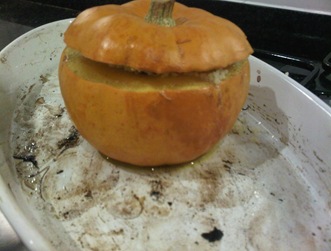
Stuffed baked baby pumpkins

I did something a bit spooky last Saturday, at lunch at the Anchor and Hope. It had nothing to do with the smoked cod’s roe or the crumbed pressed pig’s head we chose to start (though these were pretty bold and out of character for me). No. It was the fact that, for the first time ever, I opted for the vegetal main course option. Of course, I have had many vegetable-heavy dishes at restaurants in my time, but these usually star a starch of some kind: a pasta or grain, a potato, or perhaps eggs. But vegetables only? Not usually. I had the baked baby pumpkin, a couple of them in fact, oozy with cheese and chestnuts with peppery leaves and a pickled walnut on the side. And they were delicious.

I am no stranger to a pure-veg plateful at home; a ratatouille or a bowl of steaming peas or cabbage is just the job some lunchtimes. But from a restaurant menu? Usually - and rather unimaginatively – something with a little more…erm, meat to it wins the day. Especially in an old-school *gastropub* like this one (only took us a decade or so to finally get there), which always make me think of chops and burgers. After such a great start, I will certainly be ordering more vegetables in the future.

It is timely that a newly svelte (alright, svelt-er) Hugh Fearnley-Wotsisname has sworn a meat embargo on his latest programme and I am enjoying the recipes very much. So, with this meat-free plateful fresh in my memory I wanted to recreate some pumpkin magic at home last week, whilst the BSG was away. I decided to try and emulate this kind of cosy-October-wonderfulness by trying a stuffed, baked munchkin pumpkin for last night’s supper.

Having had rice in a kedgeree that morning, I was keen for something different to make up the bulk of the stuffing, so opted for couscous, but I do think with hindsight that something with a little more bite and nuttiness would have stood up far better: some wild rice or barley, perhaps.

IMG00427-20111023-1905

To stir through the grains I had roasted some onions and red pepper until their extremities were pleasingly caramelised. To these I added some Shwarma spices from our local food haven, Lebanon Gate, which would permeate throughout and fill the house with wafts of warm, festive scents. Again, with the benefit of the experience I would have gone much heavier on these spices, perhaps adding some chilli for kicks, as well as stock for added depth. And cheese - a halloumi or mozzarella perhaps - melted within would have set this particular combo off nicely…

The part of this magic spell that did work first time was the baking; once you’ve nailed this, the possibilities are endless.

After washing and drying it, I carefully sliced the ‘lid’ off the baby munchkin, scooping out the string and seeds (TIP: discard the pith but keep and dry the seeds – they make a great snack when roasted). I then oiled and seasoned the inside of the fruit, replaced the lid and baked it in a shallow dish at 200 degrees for half an hour. During this time, I prepared the filling, mixing the grains, veg and spices together. I removed the pumpkin from the oven, filled it with the stuffing, replaced its lid and baked it for another 20 minutes.

Maybe it’s rather cheeky of me to post a largely imperfect recipe plus a few tweaks and call it worthwhile. However I am acutely aware that these orange orbs will be going very cheap from tomorrow morning, once Halloween has howled itself out, so there’ll be plenty of them around to experiment on. Perhaps I’ll try some kind of stew, or a pumpkin-based daal inside them next time; whichever proves the perfect magic spell, the experience has served as a satisfying display of the versatility of the fruit: a reminder that pumpkins can be a stars of the plate and not just scary Halloween lanterns or impromptu princess transport.

IMG00425-20111023-1826

Wednesday, 12 October 2011

Something new, every day…

On Saturday I found out that my grandpa doesn’t like cheese.

Oh, he will have it in a cooked form, say, cauliflower cheese and suchlike, but cheese for cheese’s sake, on a board, say, with crackers? No thank you (or thank yoohooo, as he’d say).

I’m not sure what’s more of a surprise: the aversion itself or the fact that it has only taken me thirty-odd years to learn about it.

I know quite a lot about his eating habits, you see, having spent a great deal of my childhood with him. There was always a rush between us four siblings to be the first at breakfast so we’d get the hallowed top of the milk (when it still came in bottles from a smiling man in a float) in the crater he made in our Alpen (always Alpen, decanted into Grandpa’s special plastic container to keep it fresh). Morning after morning he’d pretend to fall for the rubber fried egg we’d plant on the kitchen floor, tirelessly feigning surprise when we picked it up with our fingers. Next to him would be his own small brown teapot, he and Gran would always drink different tea.

Grandpa has always carved the roast on Sundays – nobody else can get roast beef so thin. We’d all watch as his fork would hover back and forth over his plate during the meal, as he made sure he’d speared a bit from every part of it before taking a mouthful – the perfect mouthful. And I am pretty sure that he is the reason that the chocolate digestive - nay, the pudding - was invented.

On Saturday my nephew, George, entered the world. He is wonderful beyond words.

george
George has a few months yet before the wider universe of food begins to cross his tiny taste-buds, but what adventures await him! I hope to be along for the ride. If he’s anything like his dad he’ll have a penchant for apples (and his two middle fingers), his mum he’ll be a great cook and a mayonnaise fiend, but who knows what his dislikes will be.

The BSG tells me that babies screw up their faces at sour things as they have an inbuilt anti-poison reflex, so perhaps lemons are out for the foreseeable. I wonder when he’ll try his first bread and Marmite and if he’ll like it *fingers firmly crossed on that one*.

Perhaps he’ll be an early gourmet, like G, who as a toddler was reaching for the olives (stoneless of course). Or like Lucy who dislikes bananas and tea (not together). Who knows what will influence his tastes – or even whether they are already established; will have Grandpa’s cheeseboard-phobia? We’ll just have to wait and see.

Whilst we wait, the BSG and I are rolling out a sort of meals-on-wheels service to his parents, to get them through the days that punctuate the sleep-deprived nights.

This is the first instalment; the recipe’s grabbed from Allegra McEvedy as I am hopeless with quantities and would no doubt lead you astray with the BSG-version.

Chicken, chorizo and butterbean stew
Serves 4 (or two good suppers for the freezer)

4 chicken legs, jointed into thighs and drumsticks
2 tbsp extra virgin olive oil
250g raw chorizo sausages, thickly sliced
2 red onions, roughly chopped
2 pepper, (green or red), cut into 2cm pieces
Pinches dried oregano
Pinches dried red chilli flakes
Whole dried chillies, (optional)
120 ml white wine
2 bay leaves
2 tbsp sherry vinegar
1 x 400g can chopped plum tomatoes
1 x 400g can butter beans
500 ml chicken stock
2 oranges, grated zest only
Crusty bread, to serve

Generously season the skin of the chicken pieces with sea salt. Heat the olive oil in a large deep frying pan over a high heat and fry chicken, skin-side down for 7 minutes, until the skin is a deep golden-brown.
Season the side of the chicken facing up in the pan, turn the chicken over and fry for a further 3 minutes, or until the flesh-side is lightly golden.

Remove the chicken from the pan and set aside. Add the chorizo slices to the pan and fry on a high heat. Once the chorizo begins to release its oil, add the onion, peppers, oregano and chilli and stir well. Place a lid on the pan and leave to cook for 5–10 minutes, or until the vegetables have begun to soften.

Stir in the wine, bay leaves and sherry vinegar and bubble the mixture for 2-3 minutes, or until the volume of the liquid begins to reduce. Add the tomatoes and beans, then top up with enough chicken stock to fill the pan three quarters full and bring to a simmer.

Put the chicken back in the pan so that the flesh is in the sauce but the skin is exposed. Sprinkle over the orange zest. Bring the mixture back to the boil, then reduce the heat so the stew is gently bubbling. Simmer for 40 minutes, until the chicken is cooked all the way through and the sauce has thickened a little.

Leave the stew to rest for 15 minutes before serving with crusty bread. The stew can be made a day in advance to allow the flavours to develop.

Friday, 30 September 2011

Kedgeree (and other breakfasts.)

I never tire of food-related fantasy games. Forget 'I Spy', how about ‘your last meal on earth’, or ‘if you had to eat one meal every meal for the rest of your life, what would it be?’ Well, that second one’s easy: breakfast.
I suppose I might’ve mentioned my inability to make a decision – or perhaps I haven’t. It drives the BSG round the bend; he is decision incarnate. But this one is easy. Breakfast is a meal where anything goes, thereby removing the choice conundrum from the proceedings. Thus, breakfast is perfect for someone like me.
pancakesAs well as blurry boundaries between foodstuffs - do I plump for yoghurt, fruit or Bircher muesli, croissants or the full English? - start and end times are also a grey area, meaning that it’s quite possible to graze from waking until lunchtime. Some of my happiest and most enduring university memories are from mornings whiled away in my friend Caz’s room in halls, drinking tea and eating toast and boiled eggs, more with Marmite and perhaps just one more piece - with marmalade - until lunchtime. We may have even missed a lecture (once), waiting for the perfect runny consistency to the yolk. Nothing cements firm friendship like sharing rounds of hot-buttered toast and pots of tea.
Of course, due to obvious time constraints, weekday breakfasts are more confined to the bounds of convenience; toast and its infinite possibilities, your favourite cereal, some porridge and stewed fruit once autumn takes its crisp hold. Eggs and bacon are reserved for the week’s end - a Friday treat of a bacon and marmalade sandwich, perhaps. The BSG and I rejoice in the advent of most weekends with a proper, frothy latte from our coffee machine – smileworthy, even on the dankest of days.
speckled eggsBreakfast is a parade of wonders, where friends’ wacky combinations are frequently exposed; Caz, for example, likes marmalade and Marmite on her toast… My Belgian great-grandmother loved nothing more than to dip toast and Gouda into her morning coffee (white and strong, if you’re interested). I am ever so pleased she passed me this habit. Try it - delicious. My grandpa, the king of the avant-garde food combo, always ate his sausages with marmalade, the Tabasco and Gentleman’s Relish never far out of his reach.
Then you have breakfasts that are ideal for certain situations. This year has been full of weddings, and I don’t think that there’s a better way to start a wedding Saturday than with kedgeree. Protein- and carb- rich, it stops the gap that the skipped proper lunch will leave, lines the stomach for the inevitable afternoon drinking and wakes up the taste buds with hints of spice, lemon and parsley – just make sure you check your teeth for green bits before you leave. Definitely worth prepping in advance, it can sit and wait, warming through under foil in the oven whilst you get on with things. Deal with any fishy/oniony bits before washing and dressing in your finery – no one likes eau-de-cuisine.
You don’t need a wedding as an excuse to whip this up. I reckon it’d steel you for any big (or small) day. It might take the edge off a marathon spring clean, a looming hulk of admin or a trip to a blue-and-yellow hångår to buy silly-named flat-pack furniture, a Venus flytrap and other stuff you never knew you needed.
Kedgeree
Serves 4
4 eggs, almost hard boiled (prob 6 minutes will do) and peeled
680g smoked haddock fillets (or a mixture of smoked and unsmoked fish works too. Try mackerel.)
2 bay leaves
250g basmati rice
115g butter
1 medium onion, finely chopped
2.5 teaspoonfuls mild curry powder
Juice of half a lemon (and the other half in wedges for squeezing over)
2 good handfuls of chopped flat-leaf parsley or coriander
In a large shallow pan, heat some water (or milk) - deep enough to submerge the fish - with the bay leaves. Add the fillets, bring to the boil and simmer gently for about 5-7 minutes, until the fish is cooked. Remove the fish from the pan and, when cool enough to handle, remove the skin, flake into chunks and set aside.
Cook the rice in boiling water according to pack instructions – it should be on the al-dente side. Drain the rice, refreshing briefly under a stream of hot water from the kettle. Return the steaming rice to the saucepan, covering it with a clean tea-towel and then the lid to stand for a few minutes. This is a top-quality tip from my step-mum and it ensures the fluffiest rice imaginable.
Whilst the rice is cooking, melt the butter in a pan over a low heat, then add the onions and soften them gently without colouring for five minutes or so. Add the curry powder and cook for another couple of minutes, until the kitchen is filled with aromas. Add the rice to the pan and heat gently through, carefully folding in the flaked fish and adding the lemon juice to taste. This can now stand in a pan or dish, waiting warm under foil in a low oven until you are ready to eat.
Just before serving, add the parsley or coriander, seasoning to taste with salt and pepper. Top with the eggs cut into quarters. Serve with the lemon wedges.
Twist: For some extra texture, crispy fried onion bits are often sprinkled on the top.

Friday, 23 September 2011

Lentil and mackerel salad

Each time September rolls around, three small words strike fear into the hearts of many: Back to School. I know even 60-year olds who break into a cold sweat at the prospect – even though it’s been a few decades since they hung up their satchels. So, how to combat these misgivings? As far as I can recall, salvation would come in the form of a stationery spree – a brand new pen, a fluffy pencil case or the crisp white pages of a new diary.

For me, the lentil is the food equivalent to school – I know it’s ultimately good for me and always end up enjoying it more than I imagine. In the lentil’s case, it’s what you dress it with that makes it great. In this case: mackerel. More specifically, tinned mackerel fillets (no grappling with bones necessary).

This doesn’t sound exciting, however since signing up to Hugh’s Fish Fight and eschewing the old favourite of tuna, I have turned to tinned mackerel to top baked potatoes and fill sandwiches too. Judging by the silver-haired company I keep in that particular section of the tinned-food aisle in the supermarket, it is a food as retro as its packaging suggests.

There are certain dishes that recur often in the BSG household and alongside roast chicken and spaghetti Bolognese, this tops the list. A feel-good dish in every sense, it tastes great, is 100% good for you and elevates the lentil to another plain. There’s nothing easier to whip up after a bout of overindulgence, and I swear it makes you shout cleverer answers at University Challenge. It’s back to school without the dread, plus you usually have the wherewithal for it in your cupboards when you can’t face a food shop at the end of a long day. Enjoy its countless permutations.

Lentil and mackerel salad (I think it’s a salad)

Puy lentils

Tinned mackerel

Whatever is languishing in the fridge, but a few suggestions might be:

Cherry tomatoes, quartered

Cucumber, chopped

Radishes, chopped

Carrot, grated

Parsley

Any other soft green herbs or salad leaves wilting into anonymity in your vegetable drawer

Chilli

Lemon

Olive oil, vinegar, salt and pepper

Boil the lentils according to packet instructions, with a bay leaf and a bit of stock powder if you have any.

Whilst the lentils are boiling, chop the vegetables and herbs and put everything into a bowl. Make a salad dressing (perhaps a bit sharper than you usually have it as the lentils will slightly dull this – mustard works very well in there somewhere).

Drain the lentils, and then add them to the bowl whilst still warm – if you have used any spinach or rocket leaves, this has the pleasing effect of wilting them slightly. Drain the mackerel fillets from their oil and add them to the bowl, stirring gently through with a fork so that they slightly break up.

Add the dressing, mix and season with salt and pepper. Have a lemon on hand to squeeze over if necessary.

Enjoy a big bowlful and feel very smug.

Monday, 12 September 2011

When the chips are down

Once when I was having a very bad day, a good friend of mine told me that a slice of watermelon would make things alright – turns out that’s what he’d had to hand at the time, but it worked in all its sunshiny redness. Not long later and from this same, wise source, it was a crunchy peanut butter and raspberry jam sandwich (the details here have to be very precise). Food had done at those moments what kind words could not.

On both occasions, it was as if having such a simple treat shone a different light on everything else and gave me strength to regroup. Now, I’m not advocating comfort eating – we all know what trouble that gets people into - but I reckon its true that, when the occasion demands it, a little of something you love does you good. A teaspoon of sugar in your builder’s when you need some galvanising? Sure. A bacon sandwich on a bleary morning, or a hot chocolate grabbed after a crappy journey to work? Definitely.

Last night’s supper was a case in point; the BSG roasted half a chicken rubbed in some Australian Bush Mix (we’d in the cupboard and had been wondering what to do with) until its skin was smoky and crisp, which we shared with some homemade coleslaw (carrot, sweetheart cabbage and red onion shredded in the Magimix and dressed in yoghurt, pepper and lemon) and some wonderful, golden McCain crispy French fries*.

Really, truly, happy-making food. Thank you, darling BSG.

*I am sure that nothing beats making your own, but in the absence of a deep fat fryer for multiple cooking sessions, these frozen chips are brilliant.