Showing posts with label Autumn. Show all posts

Thursday, 28 November 2013

Pot-roast pheasant with butternut squash, Savoy cabbage and onion

The BSG is a game lover. However, after a bad experience with a sinewy, over-exercised rabbit we picked up in Lincoln a few years back, I haven’t been able to separate that gamey taste from a tough-as-old-boots food memory, so I’ve shied away from it somewhat.  So the prospect of three pheasants in our fridge, ready for the eating, filled me with dread. They say you must face your fears, so I thought I’d tackle mine head on…

When I asked the BSG what to do with it earlier that day, I received a very casual one line email: just bung it in a pot with the veg we’ve got left in the bowl and some stock and wine and cook for about 45 minutes. Easy.

OK, I thought, I can do casual, even though all I could think about was overcooking the damn thing, its stringy carcass languishing in thin, insipid juices. I made sure we had emergency freezer supplies, just in case…

But actually, what resulted was really rather good – helped by a pleasantly mild-tasting bird – and I’ll be doing it again. Not to mention easy; the very definition of a one-pot wonder. Two of us ate well, so figure that this recipe would serve three… It is easily multiplied, but increase the cooking times.

pheasant


You need:

1 onion, roughly chopped

2 bay leaves

3 juniper berries

1 large glass red wine

1/2 pint of stock

1 whole pheasant

1 clove of garlic, crushed

1/2 a butternut squash, deseeded, peeled and chopped into 1 inch pieces

1/4 savoy cabbage, sliced

a lump of beurre maniĆ©: half softened butter and plain flour (optional – or add flour to the onions at the beginning)


Preheat the oven to 190 degrees.

In a heavy based lidded pan, sweat the onions in a little oil over a medium heat until they start to colour. Add the bay leaves and juniper berries – plus a tablespoon or two of plain flour if you want to thicken the sauce.

Deglaze the pan with the red wine and add the stock. Sit the pheasant in the pan amongst the onions, add the butternut squash pieces, garlic and season. Put the lid on the pan (I added a foil cartouche as well because I thought I ought to but I’m not ever really sure what this does. It just felt right).

Put into the oven for 45 minutes or so, turning the bird over halfway through (again – this just feels proper as I always do it with my roast chicken to keep the breast moist).

Remove the pot from the oven. Check the bird is cooked then rest it on a board and take out the squash from the pan whilst you reduce the sauce over a good heat – here you can whisk in the beurre maniĆ© to thicken if you like. Season to taste. Return the squash to the pan and add the cabbage. Put the lid on the pan and let this all cook for a further 7 minutes.

Carve the pheasant breast, joint the legs and serve in a bowl on top of the vegetables with plenty of sauce poured over, like a stewy soup (yes, you’ll need a spoon too).

For extra pleasure, I recommend mashing the squash into the gravy with the back of your fork. Watch out for lead shot – it’s in there somewhere and your molars will thank you for it.

Game on…

Friday, 22 March 2013

Ratty Spanish Eggs

Ratty Baked Eggs

A couple of months back, I had breakfast at Providores on Marylebone High Street with my friend Esther, she of the highly-addictive Recipe Rifle. Spurred on by her advice (I wasn’t going to argue with a pregnant lady) and a few reviews I’d read, I plumped for a cortado – my new favourite coffee – and Turkish eggs, baked in spicy tomatoes and swimming under hot chilli butter and yogurt. They were utterly delicious and if you’re a fan of soldier-style dipping I urge you to go along and try them.

Crawling my way over the threshold after a rare hour in the gym yesterday lunchtime I was famished, yet devoid of inspiration. Honestly, I would have just eaten four pieces of toast if I’d been really stuck... However, with one egg left in the carton and a bowl of leftover ratatouille to finish off I decided to put them together.

This is more a formula than a recipe could be applied to various mushes; stews, bolognaise sauces, curries etc. Just dollop a couple of spoonfuls of whatever’s left over into an ovenproof pot or ramekin, make a comfortable nook for the egg in the middle with the back of a spoon and crack the egg into it. Drizzle over a little oil and a spice of choice – here it was paprika as I was feeling a little Spanish (Madonna’s La Isla Bonita happened to be playing on the radio). Oh, and some scrapings of a heel of Grana Padano before baking it at about 190C for 12-15 minutes or golden and slightly inflated on the top.

I ate mine with toasted wholemeal pitta, sliced into soldiers - or rather, soldados - to dip. Rather a smug working-from-home lunch I thought, when it could have so easily been Heinz Cream of Tomato...

Monday, 7 January 2013

Come Back Chicken and a Big Apple

As food goes, there’s nothing more homely than roast chicken. It was the first thing we cooked in the box-fresh oven in the new kitchen and the last thing we laid on for my sister and brother-in-law last Friday night, hours before they jetted off to a new chapter in New York. I had been desperately flicking though my mental rolodex of ways to make them stay and failing that, I settled on a dish that might remind them to return home one day…

We managed to cram in a decent enough amount of wine as well – not so much that it got too emotional – plus some passion fruit creams in little espresso cups from my Christmas copy of Kitchen Diaries II, speckled with the seeds and soaked in a pool of golden juice, which accompanied my teaspoon with every mouthful, right to the bottom.  Once blasted Banuary is over, I am going to give it a bash with other fruit as it was particularly delicious and super easy.

Passion fruit creams

What’s below is NOT rocket science obviously but how I do my roast chicken which, the BSG tells me, is pretty good. The basic formula will take on almost anything throughout the year; fresh herbs such as sage or tarragon, or wild garlic in the cavity, spices like Ras-el Hanout or Harissa and yoghurt rubbed into the skin and sit proudly alongside any salad as well as lasting you through the week. Good for the diet and the budget: what better friend could you ask for right now?

Basic Roast Chicken

You need:
1 chicken (free-range. One of those happy Woodland-roaming ones will do – not sure of the weight but should cost you between 6 and 8 pounds)
1/4 lemon
½ onion
Fresh thyme sprigs (optional)
Olive oil/butter
Salt & pepper

Remove the chicken from the fridge 10 minutes before you need it to bring it to room temperature and then place it in a roasting pan. Heat your oven to 190C. Slice the top quarter off a lemon and squeeze it over the top of the chicken before putting it into the cavity with the thyme sprigs and the half-onion. Drizzle the top and legs with oil or smear with a few knobs of butter. Season generously with salt and lightly with pepper before putting into the hot oven.

Cook for 20 minutes, before taking the tray out and turning the chicken over breast-side down (be careful here!). This should do some basting for you and ensure that everything is as juicy as possible. Return to the oven and cook for another 20 minutes before turning the chicken back over, spooning some of the basting juices over the legs. The onion, lemon or thyme may fall out at this stage, but they will go towards making lip-smacking gravy as they cook away in the tin. The skin should crisp up and brown in this last 20-30 minutes.

After between an hour and 5 minutes and an hour and a quarter’s cooking time, the chicken should be done, but to double check, insert a skewer between the leg and the breast to see if the juices run clear. It is almost always an hour and 10 minutes for me, but ovens vary. Lift the bird out and set onto a board, covering with foil if you like. It does well to rest for 10 minutes while you make the gravy; it will be juicy and easier to carve after resting.

For the gravy: drain off as much of the clear fat from the tin as you can, squeeze the remnants of the lemon quarter with the back of a spoon and keep any bits from the onion in there which have caramelised but not burnt, discarding the rest. Put the tin over a medium heat and scrape the sticky brown bits loose – they will be packing valuable chickeny flavour. Add a knob of butter and melt it. You can add a tablespoon of plain flour at this stage and cook it lightly, for thicker gravy. Add some hot or boiling water – about an espresso-cup’s worth – and a slug of white wine, smear it all together and simmer for a few minutes. Taste, adding more water and seasoning if necessary.

Tuesday, 3 April 2012

No time…St Nigella to the rescue


One pot wonder #1: Nigella’s Spanish Chicken with Chorizo and Potatoes

Spanish chicken and chorizo

Life’s a bit of a whirlwind at the moment, if ever there was a positive whirlwind. Think a helpful spiralling gust, stacking a pile of leaves neatly - just there… yup, there, in the corner - exactly where you want them, even better than you’d imagined. That is my whirlwind at the moment and I am hugely enjoying the weather conditions. The downside is that I barely have time to cook let along scribble about it (which feels distinctly like a busman’s holiday right now, I must admit).

At a time like this, when I need easy-to-assemble food, the first person I turn to is my satin-robed culinary heroine, Nigella. She is very frank about such a situation, when you can barely bring yourself to get a knife and board out. This recipe is absolutely fuss free and tastes deliciously of sunny holidays, whatever time of year you choose to make it. It went down a storm for a crowd over the weekend but was so mindless that when the thanks came – profusely – I passed them on to St Nigella in silent prayer. Some inspiration, then, for a one-pot wonder for when time is scarce or you can’t be bothered but when happy company is paramount.

I feel a few more of these coming on….

Serves: 6

  • 2 x 15ml tablespoons regular olive oil
  • 12 chicken thighs (bone in, with skin)
  • 750g chorizo sausages, whole if baby ones, or cut into 4cm chunks if regular-sized
  • 1kg new potatoes, halved
  • 2 red onions, peeled and roughly chopped
  • 2 teaspoons dried oregano
  • grated zest 1 orange

Preheat the oven to 220°C/gas mark 7. Put the oil in the bottom of 2 shallow roasting tins, 1 tablespoon in each. Rub the skin of the chicken in the oil, then turn skin-side up, 6 pieces in each tin.

Divide the chorizo sausages and the new potatoes between the 2 tins. Sprinkle the onion and the oregano over, then grate the orange zest over the contents of the 2 tins.*

Cook for 1 hour, but after 30 minutes, swap the top tray with the bottom tray in the oven and baste the contents with the orange-coloured juices.

*the BSG suggested another drizzling of olive oil at this stage, which made for extra chorizo-ey juices to mop up with stray potatoes and pieces of bread from the tray plonked between us, proving his expert ‘improving-on-perfection’ skills. If you have just one enormous tray, this seems to do for it all just as well as two.

Tuesday, 15 November 2011

A salad of fennel, orange, Parmesan and hazelnuts

Before I started working from home I had this romantic notion that I would float between desk and kitchen, keeping a vague eye on something wholesome on the stove or in the oven, blipping away until lunchtime. Now that I’ve worked here a year, I can testify to devoting even less time towards my lunch at home than I did when I had to rely on the ubiquitous sandwich chains for the weekly rotation of wraps, salads and soups – most of the time; there constantly seems to be something else that needs my attention.

Yesterday, however, was a punctuation mark of a lunch, a seagull-topped buoy on the recent sea of lacklustre lunches, and it’s inspired me to make more of an effort even though it’s only me. After all, lunch is pretty important, in the grand scheme of things.

Like all the best food daydreams, this one had an outside chance of becoming a reality as I happened to have all the ingredients in question. And the reality was delicious.

Serves 1 (or 2 as a starter)

1 bulb fennel

8 good shavings off a block of good Parmesan

Handful of crushed hazelnuts

1 orange

For the dressing:

Cider/white wine vinegar

Mustard

Olive oil

Salt and pepper

Slice the very bottom off the fennel bulb and wash/discard any manky outer layers. Slice it very finely, or better still, shave it with a vegetable peeler (or – yikes! – a mandolin).

Peel and halve the orange, discarding any pips, and slice.

Make the dressing to taste (but a mustardy, zingy slick is best).

Dress and mix the fennel, nuts, cheese and orange slices in a bowl.

Eat directly from said bowl if you can stay away from your desk no longer.

Monday, 31 October 2011

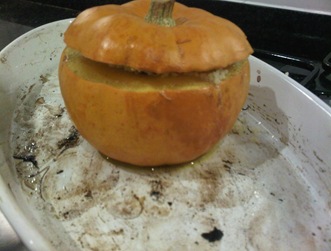
Stuffed baked baby pumpkins

I did something a bit spooky last Saturday, at lunch at the Anchor and Hope. It had nothing to do with the smoked cod’s roe or the crumbed pressed pig’s head we chose to start (though these were pretty bold and out of character for me). No. It was the fact that, for the first time ever, I opted for the vegetal main course option. Of course, I have had many vegetable-heavy dishes at restaurants in my time, but these usually star a starch of some kind: a pasta or grain, a potato, or perhaps eggs. But vegetables only? Not usually. I had the baked baby pumpkin, a couple of them in fact, oozy with cheese and chestnuts with peppery leaves and a pickled walnut on the side. And they were delicious.

I am no stranger to a pure-veg plateful at home; a ratatouille or a bowl of steaming peas or cabbage is just the job some lunchtimes. But from a restaurant menu? Usually - and rather unimaginatively – something with a little more…erm, meat to it wins the day. Especially in an old-school *gastropub* like this one (only took us a decade or so to finally get there), which always make me think of chops and burgers. After such a great start, I will certainly be ordering more vegetables in the future.

It is timely that a newly svelte (alright, svelt-er) Hugh Fearnley-Wotsisname has sworn a meat embargo on his latest programme and I am enjoying the recipes very much. So, with this meat-free plateful fresh in my memory I wanted to recreate some pumpkin magic at home last week, whilst the BSG was away. I decided to try and emulate this kind of cosy-October-wonderfulness by trying a stuffed, baked munchkin pumpkin for last night’s supper.

Having had rice in a kedgeree that morning, I was keen for something different to make up the bulk of the stuffing, so opted for couscous, but I do think with hindsight that something with a little more bite and nuttiness would have stood up far better: some wild rice or barley, perhaps.

IMG00427-20111023-1905

To stir through the grains I had roasted some onions and red pepper until their extremities were pleasingly caramelised. To these I added some Shwarma spices from our local food haven, Lebanon Gate, which would permeate throughout and fill the house with wafts of warm, festive scents. Again, with the benefit of the experience I would have gone much heavier on these spices, perhaps adding some chilli for kicks, as well as stock for added depth. And cheese - a halloumi or mozzarella perhaps - melted within would have set this particular combo off nicely…

The part of this magic spell that did work first time was the baking; once you’ve nailed this, the possibilities are endless.

After washing and drying it, I carefully sliced the ‘lid’ off the baby munchkin, scooping out the string and seeds (TIP: discard the pith but keep and dry the seeds – they make a great snack when roasted). I then oiled and seasoned the inside of the fruit, replaced the lid and baked it in a shallow dish at 200 degrees for half an hour. During this time, I prepared the filling, mixing the grains, veg and spices together. I removed the pumpkin from the oven, filled it with the stuffing, replaced its lid and baked it for another 20 minutes.

Maybe it’s rather cheeky of me to post a largely imperfect recipe plus a few tweaks and call it worthwhile. However I am acutely aware that these orange orbs will be going very cheap from tomorrow morning, once Halloween has howled itself out, so there’ll be plenty of them around to experiment on. Perhaps I’ll try some kind of stew, or a pumpkin-based daal inside them next time; whichever proves the perfect magic spell, the experience has served as a satisfying display of the versatility of the fruit: a reminder that pumpkins can be a stars of the plate and not just scary Halloween lanterns or impromptu princess transport.

IMG00425-20111023-1826

Friday, 30 September 2011

Kedgeree (and other breakfasts.)

I never tire of food-related fantasy games. Forget 'I Spy', how about ‘your last meal on earth’, or ‘if you had to eat one meal every meal for the rest of your life, what would it be?’ Well, that second one’s easy: breakfast.
I suppose I might’ve mentioned my inability to make a decision – or perhaps I haven’t. It drives the BSG round the bend; he is decision incarnate. But this one is easy. Breakfast is a meal where anything goes, thereby removing the choice conundrum from the proceedings. Thus, breakfast is perfect for someone like me.
pancakesAs well as blurry boundaries between foodstuffs - do I plump for yoghurt, fruit or Bircher muesli, croissants or the full English? - start and end times are also a grey area, meaning that it’s quite possible to graze from waking until lunchtime. Some of my happiest and most enduring university memories are from mornings whiled away in my friend Caz’s room in halls, drinking tea and eating toast and boiled eggs, more with Marmite and perhaps just one more piece - with marmalade - until lunchtime. We may have even missed a lecture (once), waiting for the perfect runny consistency to the yolk. Nothing cements firm friendship like sharing rounds of hot-buttered toast and pots of tea.
Of course, due to obvious time constraints, weekday breakfasts are more confined to the bounds of convenience; toast and its infinite possibilities, your favourite cereal, some porridge and stewed fruit once autumn takes its crisp hold. Eggs and bacon are reserved for the week’s end - a Friday treat of a bacon and marmalade sandwich, perhaps. The BSG and I rejoice in the advent of most weekends with a proper, frothy latte from our coffee machine – smileworthy, even on the dankest of days.
speckled eggsBreakfast is a parade of wonders, where friends’ wacky combinations are frequently exposed; Caz, for example, likes marmalade and Marmite on her toast… My Belgian great-grandmother loved nothing more than to dip toast and Gouda into her morning coffee (white and strong, if you’re interested). I am ever so pleased she passed me this habit. Try it - delicious. My grandpa, the king of the avant-garde food combo, always ate his sausages with marmalade, the Tabasco and Gentleman’s Relish never far out of his reach.
Then you have breakfasts that are ideal for certain situations. This year has been full of weddings, and I don’t think that there’s a better way to start a wedding Saturday than with kedgeree. Protein- and carb- rich, it stops the gap that the skipped proper lunch will leave, lines the stomach for the inevitable afternoon drinking and wakes up the taste buds with hints of spice, lemon and parsley – just make sure you check your teeth for green bits before you leave. Definitely worth prepping in advance, it can sit and wait, warming through under foil in the oven whilst you get on with things. Deal with any fishy/oniony bits before washing and dressing in your finery – no one likes eau-de-cuisine.
You don’t need a wedding as an excuse to whip this up. I reckon it’d steel you for any big (or small) day. It might take the edge off a marathon spring clean, a looming hulk of admin or a trip to a blue-and-yellow hĆ„ngĆ„r to buy silly-named flat-pack furniture, a Venus flytrap and other stuff you never knew you needed.
Kedgeree
Serves 4
4 eggs, almost hard boiled (prob 6 minutes will do) and peeled
680g smoked haddock fillets (or a mixture of smoked and unsmoked fish works too. Try mackerel.)
2 bay leaves
250g basmati rice
115g butter
1 medium onion, finely chopped
2.5 teaspoonfuls mild curry powder
Juice of half a lemon (and the other half in wedges for squeezing over)
2 good handfuls of chopped flat-leaf parsley or coriander
In a large shallow pan, heat some water (or milk) - deep enough to submerge the fish - with the bay leaves. Add the fillets, bring to the boil and simmer gently for about 5-7 minutes, until the fish is cooked. Remove the fish from the pan and, when cool enough to handle, remove the skin, flake into chunks and set aside.
Cook the rice in boiling water according to pack instructions – it should be on the al-dente side. Drain the rice, refreshing briefly under a stream of hot water from the kettle. Return the steaming rice to the saucepan, covering it with a clean tea-towel and then the lid to stand for a few minutes. This is a top-quality tip from my step-mum and it ensures the fluffiest rice imaginable.
Whilst the rice is cooking, melt the butter in a pan over a low heat, then add the onions and soften them gently without colouring for five minutes or so. Add the curry powder and cook for another couple of minutes, until the kitchen is filled with aromas. Add the rice to the pan and heat gently through, carefully folding in the flaked fish and adding the lemon juice to taste. This can now stand in a pan or dish, waiting warm under foil in a low oven until you are ready to eat.
Just before serving, add the parsley or coriander, seasoning to taste with salt and pepper. Top with the eggs cut into quarters. Serve with the lemon wedges.
Twist: For some extra texture, crispy fried onion bits are often sprinkled on the top.

Friday, 23 September 2011

Lentil and mackerel salad

Each time September rolls around, three small words strike fear into the hearts of many: Back to School. I know even 60-year olds who break into a cold sweat at the prospect – even though it’s been a few decades since they hung up their satchels. So, how to combat these misgivings? As far as I can recall, salvation would come in the form of a stationery spree – a brand new pen, a fluffy pencil case or the crisp white pages of a new diary.

For me, the lentil is the food equivalent to school – I know it’s ultimately good for me and always end up enjoying it more than I imagine. In the lentil’s case, it’s what you dress it with that makes it great. In this case: mackerel. More specifically, tinned mackerel fillets (no grappling with bones necessary).

This doesn’t sound exciting, however since signing up to Hugh’s Fish Fight and eschewing the old favourite of tuna, I have turned to tinned mackerel to top baked potatoes and fill sandwiches too. Judging by the silver-haired company I keep in that particular section of the tinned-food aisle in the supermarket, it is a food as retro as its packaging suggests.

There are certain dishes that recur often in the BSG household and alongside roast chicken and spaghetti Bolognese, this tops the list. A feel-good dish in every sense, it tastes great, is 100% good for you and elevates the lentil to another plain. There’s nothing easier to whip up after a bout of overindulgence, and I swear it makes you shout cleverer answers at University Challenge. It’s back to school without the dread, plus you usually have the wherewithal for it in your cupboards when you can’t face a food shop at the end of a long day. Enjoy its countless permutations.

Lentil and mackerel salad (I think it’s a salad)

Puy lentils

Tinned mackerel

Whatever is languishing in the fridge, but a few suggestions might be:

Cherry tomatoes, quartered

Cucumber, chopped

Radishes, chopped

Carrot, grated

Parsley

Any other soft green herbs or salad leaves wilting into anonymity in your vegetable drawer

Chilli

Lemon

Olive oil, vinegar, salt and pepper

Boil the lentils according to packet instructions, with a bay leaf and a bit of stock powder if you have any.

Whilst the lentils are boiling, chop the vegetables and herbs and put everything into a bowl. Make a salad dressing (perhaps a bit sharper than you usually have it as the lentils will slightly dull this – mustard works very well in there somewhere).

Drain the lentils, and then add them to the bowl whilst still warm – if you have used any spinach or rocket leaves, this has the pleasing effect of wilting them slightly. Drain the mackerel fillets from their oil and add them to the bowl, stirring gently through with a fork so that they slightly break up.

Add the dressing, mix and season with salt and pepper. Have a lemon on hand to squeeze over if necessary.

Enjoy a big bowlful and feel very smug.

Wednesday, 30 September 2009

A time to gather

I know this blog primarily centres on taste but, in terms of memories and associations, smells are equally evocative, if not more so. How appropriate that wood smoke, a breath of it lacing the evening mist as we arrived in Norfolk on Friday, is for me a comforting scent of home. It transports me to countless afternoons spent clearing (ragging about in) woods as children, building huge bonfires with Dad and Grandpa and watching them crackle. Then if we were very lucky we’d wave a marshmallow on a stick at the embers until the doughy white skin blistered brown and started to ooze. This was usually the stage at which we lost them to the fire, making the eating all the more pleasurable.

Despite recent Indian Summer-like days, those damp mushroomy notes of autumn have returned to the countryside; the perfect accompaniment to the spike of smoke, pricking our nostrils and calling to our olfactory gear just as the springtime called Mr. Mole out of his burrow in The Wind in the Willows. It makes you want to wrap up and get outside for walks, to light the fire and be cosy. On Friday we ate at our warm and welcoming local pub, The Dabbling Duck, which was celebrating British Food Fortnight with some very British dishes, steak and kidney puddings and crumble with custard among them. The BSG’s Lancashire Hotpot didn’t touch the sides. I plumped for fish in a golden batter, with enormous chips and minted mushy peas – it was Friday after all!

P1050361

Each season brings its own welcome scents; one of the roses in the garden smells so sweet, like the most delicate cup of tea imaginable, its petal-packed heads flower twice a year. At the height of summer, the swathes of lavender under the windows exude a heady fragrance, as they heave with bees (which incidentally have a very keen sense of smell – honeybees have been trained to detect landmines), clamouring for their hit, and as the heads are warmed by the sun, by the evening it is intoxicating. However there is a power to autumn’s earthy aromas, when evidence of nature’s industry is in such abundance, and something deeper, winter, waits beneath the surface. The hedgerows heave with berries, fruits and seedpods, furnishing their occupants with storable riches before they close down for the year.

Thoughts drift to mushroom-hunting excursions amongst the leaf litter - until you realise that Nature being Nature doesn’t make any one thing that looks like the photo in the fungi book, but rather several of them. Which is it; the ‘slow agonising death on ingestion’ one or the ‘very nice with toast’? The ensuing 45 minutes is spent flicking though the book several times to make absolutely sure, then abandon the mission in favour of the more hazardous in appearance but far lower fatal-seizure-risk chestnut (nut allergy sufferers excepted). As I write this I am lunching on a velvety mushroom soup: I am sure that the very nice person who picked these enjoys the fact that their patch isn’t full of idiots keeling over every half hour, so I’d say its definitely something best left to people who know, save perhaps a couple of flat field mushrooms from a damp pasture – and you know what they grow out of…

red cabbage

Feeling guilty at the drifts of apples littering the garden, uneaten and neglected, the BSG and I decided to bring them back and make them into a chutney or 20. And we didn’t stop there – at his Mum’s house we took pity on some unripe green peaches and he ploughed through the cookery books until he found a pickle to include them. Our kitchen has become a job-centre for unemployed fruit. Thank goodness we take in homeless jars, too. While we were at it, why not pickle some red cabbage too? Speaking of smells, the eye-watering sting of malt vinegar is not something I miss once it’s gone…

chutney raw

I am not averse to the odd present, and when the BSG returned from a recent work trip he gave me a pot of gold. Wow. A proper giant’s jar of French moutarde, in a rustic-looking (read more expensive) ceramic pot - which I’ll hang on to for storing salt - it has a very pleasing sulphur colour and a sharp tang. Even luckier for me then, that the BSG served up a perfect rare steak, served on sliced beetroot slicked in horseradish and a crisp green salad to celebrate its first outing. I hear you say that horseradish AND mustard is a belt and braces approach to a steak, but I couldn’t resist.

steak mustard salad