Showing posts with label supper. Show all posts

Tuesday, 28 January 2014

The Shed. No tears.

Soon we’ll be leaving this lovely part of London and if there’s a place I wish we could take with us, it’s the Shed.

No, not our shed - though I am rather fond of it now, having done a timely re-felt with the BSG last autumn before Noah’s rains arrived. I mean The Shed, a very lovely nook of a place run by a pair of cheery and talented brothers in Notting Hill. With the menu changing every week, there’s a strong emphasis on seasonal produce (many sourced from the family farm and vineyard in Sussex) and each ingredient is seldom anything but exquisitely treated. If there’s ever a place that urges you to treasure and savour every component on the plate, it’s The Shed.

Across the board, from game and fish to veg and foraged ingredients, seasonal food is the VIP. I often imagine it sitting on a plumped up cushion in its crate or box as it awaits its time to shine in the kitchen. Speaking of which, you may want to ask for a ‘comfortable’ perch when you call to book a table, especially if, like me at the moment, you can’t quite manage a tractor-seat stool, legs astride an oil barrel gracefully. But I ‘spose that’s better than you’d get in my shed…

With small sharing plates between you, you come out feeling happily sated rather than stuffed. However be warned: you may get overexcited… Even off the sauce (instead we sipped on a delicious blood orange loosener with rosemary sugar and lime), we racked up a fair amount. Four plates between two (and three quarters), plus pudding made for a very good lunch indeed.

I am hooked: I went twice this week. I realised I’d already been three times - without the BSG. Criminal. Plus, if we got in there on Saturday, he’d still be lucky enough to catch the perfection that was the pear tart I tried on Thursday, made with cooked down Comice pears alongside a hazelnut praline cream. Parting is such sweet sorrow.

(Still, I hope to take a bit with me – they tell me they’ve a cookbook coming out soon. Goody.)


Here’s what we ate. Purty, ain’t it?

broccoli

Tempura tenderstem broccoli with chilli and a dipping sauce


venison ragu

Venison ragu and black pepper pappardelle


sprots

Quail and homemade BBQ sauce. Shaved sprouts, apple, cheddar and nuts.


beef

Beef cigars with mustard mayonnaise.


pear tart

Finally, that AMAZING pear tart…

(and a teeny marmalade frangipane. More about that next time…)

Thursday, 28 November 2013

Pot-roast pheasant with butternut squash, Savoy cabbage and onion

The BSG is a game lover. However, after a bad experience with a sinewy, over-exercised rabbit we picked up in Lincoln a few years back, I haven’t been able to separate that gamey taste from a tough-as-old-boots food memory, so I’ve shied away from it somewhat.  So the prospect of three pheasants in our fridge, ready for the eating, filled me with dread. They say you must face your fears, so I thought I’d tackle mine head on…

When I asked the BSG what to do with it earlier that day, I received a very casual one line email: just bung it in a pot with the veg we’ve got left in the bowl and some stock and wine and cook for about 45 minutes. Easy.

OK, I thought, I can do casual, even though all I could think about was overcooking the damn thing, its stringy carcass languishing in thin, insipid juices. I made sure we had emergency freezer supplies, just in case…

But actually, what resulted was really rather good – helped by a pleasantly mild-tasting bird – and I’ll be doing it again. Not to mention easy; the very definition of a one-pot wonder. Two of us ate well, so figure that this recipe would serve three… It is easily multiplied, but increase the cooking times.

pheasant


You need:

1 onion, roughly chopped

2 bay leaves

3 juniper berries

1 large glass red wine

1/2 pint of stock

1 whole pheasant

1 clove of garlic, crushed

1/2 a butternut squash, deseeded, peeled and chopped into 1 inch pieces

1/4 savoy cabbage, sliced

a lump of beurre manié: half softened butter and plain flour (optional – or add flour to the onions at the beginning)


Preheat the oven to 190 degrees.

In a heavy based lidded pan, sweat the onions in a little oil over a medium heat until they start to colour. Add the bay leaves and juniper berries – plus a tablespoon or two of plain flour if you want to thicken the sauce.

Deglaze the pan with the red wine and add the stock. Sit the pheasant in the pan amongst the onions, add the butternut squash pieces, garlic and season. Put the lid on the pan (I added a foil cartouche as well because I thought I ought to but I’m not ever really sure what this does. It just felt right).

Put into the oven for 45 minutes or so, turning the bird over halfway through (again – this just feels proper as I always do it with my roast chicken to keep the breast moist).

Remove the pot from the oven. Check the bird is cooked then rest it on a board and take out the squash from the pan whilst you reduce the sauce over a good heat – here you can whisk in the beurre manié to thicken if you like. Season to taste. Return the squash to the pan and add the cabbage. Put the lid on the pan and let this all cook for a further 7 minutes.

Carve the pheasant breast, joint the legs and serve in a bowl on top of the vegetables with plenty of sauce poured over, like a stewy soup (yes, you’ll need a spoon too).

For extra pleasure, I recommend mashing the squash into the gravy with the back of your fork. Watch out for lead shot – it’s in there somewhere and your molars will thank you for it.

Game on…

Tuesday, 9 April 2013

Lemony Quinoa with Shiitake, Chicken & Coriander

quinoa

They say that much like there’s a book in everyone, there’s a marathon in everyone. Well I’m not at all sure who ‘they’ are, but ‘they’ omit a major sub-clause: that many books and marathons should stay firmly put.

Our friend James is running the London marathon this year. The thing that most surprises us about this is the fact that it will be his first. Seriously, he is ALWAYS on a run. Another surprising development is that he has asked us for some advice – not with the running element you understand, but the nutritional one:

What to eat on marathon eve?

Of course, this required extensive expert research so I embarked on my Googling post-haste. Results? NO to anything too heavy, nothing wildly experimental, spicy or likely to make you vom (shellfish etc). It’s too late for carb-loading (exactly what it says on the tin) which you should have been doing for the last few days, so perhaps not too much of that simple starchy stuff. YES to lean protein, complex carbs and vegetables: light but filling. Presumably too, I thought from my now-expert perch, not a dish that would take an age to knock up for someone preoccupied with zenlike mental preparation, with laying out the double-layered anti-blister running socks, the lime-green Lycra number that wicks away sweat - or the novelty giant hand costume.

Gah! It all sounded so worthy and boring, I was stumped…

I turned away from the computer and sought solace in the cookbook library. After an extensive peruse I lighted upon this wonderful dish, from the gorgeous Around the World in 80 Dishes by the multitalented photographer David Loftus (How he had time to compile his own BOOK as well as everything else he manages I don’t know, but we are pleased that he did). If Phileas Fogg had eaten this well, it would have taken him a lot longer to get home.

This recipe has totally cured me of my mistrust of quinoa (something I also thought sounded worthy and boring). It is easy to put together (once you’ve done some dry toasting of sesame seeds and quinoa), it’s balanced, fresh and delicious. It hails from California and you can almost feel the golden sunshine as you eat it (plus, Californians are COOL). The BSG and I had it for a very happy supper (he was on a marathon cook-up for his recuperating sister) last week, and again this week, subbing the chicken out for crisp-skinned baked salmon.

Try it Jimbo – it should keep you light on your feet. And if you don’t manage it in under 3 hours, don’t go blaming me – it’s a silly idea anyway.

Mr Loftus’s friend Domenica Catelli, whose recipe this is, says that it feeds 6 skinny Californians.
Divide by two to sate two greedy Londoners (with some for lunch)
….or one worthy marathon runner.

Lemony Quinoa with Shiitake, Chicken & Coriander

350g quinoa
2 tbsp extra virgin olive oil
1 medium onion, chopped
3 cloves of garlic, minced
110g shiitake mushrooms, thinly sliced
2 organic chicken breasts cut into ¼ inch pieces
Salt and freshly ground black pepper
1 litre vegetable stock
2 medium courgettes cut into ¼ inch pieces
Juice of 2 lemons
3 tbsp toasted sesame seeds
Small bunch fresh coriander
Extra virgin olive oil, to drizzle

Toast the quinoa in a dry pan, then rinse it under running water and drain (I would also toast the seame seeds now if you need to and keep them to one side).
Heat the oil in a medium pan, then add the onions and garlic and sauté for 1 minute. Add the shitake mushrooms and cook for a few minutes more.
Add the quinoa and the chicken, season with salt and pepper and add the stock. Bring to the boil, cover the pan, then reduce the heat to low and cook for 15 minutes, until the ingredients are well combined and the chicken is cooked through.
Remove the lid, and add the courgettes , lemon juice, sesame seeds and three quarters if the coriander. Turn off the heat underneath the pan, replace the lid on top and leave for 2 minutes more.
Finish with the remaining coriander and a drizzle of good olive oil, and season with salt and pepper.

TIP: toasting the quinoa in a dry pan brings more depth to the flavour

Monday, 7 January 2013

Come Back Chicken and a Big Apple

As food goes, there’s nothing more homely than roast chicken. It was the first thing we cooked in the box-fresh oven in the new kitchen and the last thing we laid on for my sister and brother-in-law last Friday night, hours before they jetted off to a new chapter in New York. I had been desperately flicking though my mental rolodex of ways to make them stay and failing that, I settled on a dish that might remind them to return home one day…

We managed to cram in a decent enough amount of wine as well – not so much that it got too emotional – plus some passion fruit creams in little espresso cups from my Christmas copy of Kitchen Diaries II, speckled with the seeds and soaked in a pool of golden juice, which accompanied my teaspoon with every mouthful, right to the bottom.  Once blasted Banuary is over, I am going to give it a bash with other fruit as it was particularly delicious and super easy.

Passion fruit creams

What’s below is NOT rocket science obviously but how I do my roast chicken which, the BSG tells me, is pretty good. The basic formula will take on almost anything throughout the year; fresh herbs such as sage or tarragon, or wild garlic in the cavity, spices like Ras-el Hanout or Harissa and yoghurt rubbed into the skin and sit proudly alongside any salad as well as lasting you through the week. Good for the diet and the budget: what better friend could you ask for right now?

Basic Roast Chicken

You need:
1 chicken (free-range. One of those happy Woodland-roaming ones will do – not sure of the weight but should cost you between 6 and 8 pounds)
1/4 lemon
½ onion
Fresh thyme sprigs (optional)
Olive oil/butter
Salt & pepper

Remove the chicken from the fridge 10 minutes before you need it to bring it to room temperature and then place it in a roasting pan. Heat your oven to 190C. Slice the top quarter off a lemon and squeeze it over the top of the chicken before putting it into the cavity with the thyme sprigs and the half-onion. Drizzle the top and legs with oil or smear with a few knobs of butter. Season generously with salt and lightly with pepper before putting into the hot oven.

Cook for 20 minutes, before taking the tray out and turning the chicken over breast-side down (be careful here!). This should do some basting for you and ensure that everything is as juicy as possible. Return to the oven and cook for another 20 minutes before turning the chicken back over, spooning some of the basting juices over the legs. The onion, lemon or thyme may fall out at this stage, but they will go towards making lip-smacking gravy as they cook away in the tin. The skin should crisp up and brown in this last 20-30 minutes.

After between an hour and 5 minutes and an hour and a quarter’s cooking time, the chicken should be done, but to double check, insert a skewer between the leg and the breast to see if the juices run clear. It is almost always an hour and 10 minutes for me, but ovens vary. Lift the bird out and set onto a board, covering with foil if you like. It does well to rest for 10 minutes while you make the gravy; it will be juicy and easier to carve after resting.

For the gravy: drain off as much of the clear fat from the tin as you can, squeeze the remnants of the lemon quarter with the back of a spoon and keep any bits from the onion in there which have caramelised but not burnt, discarding the rest. Put the tin over a medium heat and scrape the sticky brown bits loose – they will be packing valuable chickeny flavour. Add a knob of butter and melt it. You can add a tablespoon of plain flour at this stage and cook it lightly, for thicker gravy. Add some hot or boiling water – about an espresso-cup’s worth – and a slug of white wine, smear it all together and simmer for a few minutes. Taste, adding more water and seasoning if necessary.

Friday, 16 November 2012

Zanzibar Fish Curry & Coriander Yoghurt

P1100795   P1100791
Last week we decided to counteract the impending darkness of November by heading for the spice isle.

Not that spice aisle, though it’s rather popular in our house, but the Gauguin-green, beguiling beauty that is Zanzibar, the one one-time hub of the spice trade – and a great deal less palatably, the slave-trade between Africa and the world.
And Freddie Mercury was born there.

She, let’s call her she, has had more outside influences than I have had hot dinners (and that’s a lot); Oman, Portugal, the list goes on. The old part of the capital, Stone Town, witnessed the shortest war in the world at the end of the 19th century: the Anglo-Zanzibar war, which lasted all of between 38 and 45 minutes depending on who you ask. This amazing piece of trivia has not only been banked by the BSG amongst his treasury of random facts, but is greatly bumped up his favourites chart due to the fact that it was begun at about 9am… once the British had finished their breakfast.

Our breakfasts each day were altogether more peaceful affairs, consisting of some of the greatest tasting fruit I have ever encountered. Every bright orange mango was a good one, the bananas were short and sweet and the custard apples were a revelation. Considering that pineapples were brought over by the Portuguese - so aren’t strictly native to Zanzibar - it’s hard to imagine them tasting better grown anywhere else.
P1100822 P1100849 P1100843

Of course, some food tourism was inevitable, and between bouts of competitive reading and swimming sessions we took a spice tour, to see the origins of the spices we know so well in their orange-topped jars; I have a new-found respect for each and every one. Fresh  nutmeg looked like a formidable armoured beetle, black in its in its danger-red mace casing. The turmeric and ginger roots were fiery when scratched out of their earthy bed and the cardamom and cloves unrecognisable in their pungent greenness*. Huge almond trees provided cool shade underneath dark, waxy leaves. Like all good tourists, we spent a small fortune in Tanzania Shillings on a few bags of the stuff, still drunk on raw nutmeg, ginger and turmeric. One of the bags contains a rust-hued curry powder, the same colour as Zanzibar’s fertile ground. We used it this week to make a fish curry; the closest to kissing the spice isle a fond farewell, until the next time. Asante sana!

* pics from left to right: cardamom, nutmeg, cloves

The mix looks like a lot, but chances are you have nearly everything in your cupboard already. Make up a big batch and keep it to use again and again - I guarantee you’ll want to. Equally it will make a great meat or veg curry too. It takes no time at all to put together.

For the curry:
1 onion, chopped
Zanzibar spice mix (ground turmeric, cumin, cardamom, cinnamon, cloves, chilli powder, coriander and garlic)
500g skin and boneless firm white fish (or a mix including squid and shellfish) in bitesized pieces
1 carrot and 1 courgette, chopped into short batons
Tin of chopped tomatoes
Tin of coconut milk
Salt and pepper

For the yoghurt:
3 tablespoons Greek yoghurt
Handful of chopped fresh coriander
1 teaspoon grated lemon zest
Salt and pepper

Soften and lightly colour the onion over a gentle heat. Add the mix of powdered spices and cook for 2 minutes. Add chopped tomatoes and carrot pieces, turn up the heat and simmer for 10 minutes. Add coconut milk and turn down the heat. Cook for 5 minutes, before adding the courgette and fish. Place a lid on the pan and cook for 5 minutes, until the fish is cooked through.

Serve with the coriander yoghurt, some warm chapati (or rice) and cauliflower cooked in ginger, turmeric, cumin and cinnamon.


P1100935

Friday, 20 July 2012

A Salmoriglio summer

P1100606

I am rather fond of Champagne, all of the time. But I particularly like it when it’s not supposed to be there; like when it’s a Tuesday, with a takeaway, or alongside beans on toast just because you feel like it - that kind of thing. Last night was one of those such moments – the BSG and I had it (rather too much of it…) with our Italian fennel sausages, ratatouille and polenta. Oh, and a zingy Italian sauce: my new favourite thing.

I think I have mentioned in the past that absolutely nothing grows in our garden that I would like to be there, in fact random uninvited plants have taken root much more successfully than invited ones, so I have nobly let them stay. One exception and a product of all this rain is our marjoram/oregano (still not quite sure which it is – but for today’s ends, let’s call it the latter). It is a sprawling, fragrant monster and I love to brush my hand over it and scrunch it to release the aromas into the air. As well as scrunching it, I thought I might have to think of something clever to make with it.

And there it was, the answer, salmoriglio. An Italian recipe required expertise of the highest order in that cuisine so I went to those legendary River Café ladies. Their blue book offered me what I sought and oh, what an amazing, pungent offering. Move over, salsa verde. So long, mayo, mustard and ketchup. This heady paste is my sauce for the coming months, it sounds like sunshine, is great with fish, meat, veg, eggs, rice, everything. And apparently summer’s here….at last.

Here’s the recipe. The BSG and I threw armfuls of the stuff into the mix. YUM.

P1100594  P1100604

Salmoriglio – from the River Cafe Cookbook (BLUE)

(I reckon you will want to quadruple this, but shouldn’t think it keeps that well – gets grassier by the minute, so make as fresh as possible, as and when you need it)

4 level tablespoons fresh oregano/marjoram
1 teaspoon sea salt
2 tablespoons lemon juice
8 tablespoons extra virgin olive oil
Freshly ground black pepper

In a pestle and mortar pound the herb leaves with the salt until completely crushed. Add the lemon juice. Pour the oil slowly into the mixture. Add a little pepper.

Tuesday, 5 June 2012

Stuffed Tomatoes

I can be a creature of habit when it comes to urges of the gastronomic variety. Most of the time, the BSG doesn't even have to ask me what I'd like on my toast of a morning, instead he reaches knowingly for the black stuff, all dressed up as it is at the moment in its special Jubilee jar. So I am in good company there, then.

For instance, I happen to have had smoked mackerel pate and oatcakes pretty much exclusively for the last three lunches - and I don't mind, because just thinking about it now makes me want to make it a fourth. I like to think of these not as imaginative ruts I’m stuck in, but little enclaves of comfort; the marmite and lettuce sandwich with the glass (had to be glass, not plastic, you understand) of milk I always had doing my homework at my gran’s house; the fish fingers Mum would give us, their crunchy orange crumb skin in curling and crisp disarray, for breakfast on cold wintry mornings when she wanted us off to school without any fuss. Once I’d found a hit I saw no reason to divert from it, and I suppose I am still like that to an extent. Goodness knows what I'd be like as a pregnant person, legitimately allowed to indulge such cravings. Or perhaps I would eat normally….

On holidays as children, we all clung doggedly to anything familiar in the eating department. Menus were Greek to us, in every sense, and we gave the Souvlaki and Moussaka a wide berth in favour of stale basket bread, cucumber salad drenched in olive oil and vinegar and wine diluted with water (which was foul but delicious to us as it was so grown up). There was, however, one exception: the stuffed tomato. I can still remember the first one I had, and none since has ever been as good in my mind. They have stuck firmly on the holiday repertoire ever since, though I am a little more adventurous now.

I know they might be a little bit 70’s, but who said that oldies aren’t goodies? Just look at HRH – she just gets better, in my view.

I am yet to find a brilliant recipe for this but summer(!) seems the perfect time to make the most of these amazing fruits, with their greenhouse smell and plump redness. The BSG and I tried this week, and we'll keep on trying. The following recipe is from the book Twelve: A Tuscan Cookbook, by Tessa Kiros. We added cinnamon and used orzo pasta instead of rice, bundling it up with a whole load of spare soft green herbs and a dollop of creme fraiche to finish. But the search for that perfect stuffed tomato continues…


Pomodori con Riso

6 medium sized ripe, round tomatoes

5 tablespoons olive oil

3 garlic cloves, chopped

250g long-grain rice (e.g. basmati)

250 ml (1 cup) water

1 stalk celery, trimmed and finely chopped

Good pinch ground cinnamon

4 tablespoons grated parmesan cheese

10 basil leaves , roughly chopped and any other soft green herbs you can lay your hands on

breadcrumbs (optional)


Preheat the oven to 180C. Slice the tops off of the tomatoes and set aside. Carefully, scoop out the flesh of the tomatoes with a spoon, taking care not to break the tomato shells. Put the tomato shells into a baking dish, without overlapping and leaving a little space between. Using a little salt, season inside and outside the shells. Puree the tomato flesh with a stick blender or in a blender.

Heat 2 tbsps of the oil in a small saucepan with the garlic. Add the rice and the celery, and stir in the oil for a minute. Add half a cup of water and the tomato puree and cinnamon and season with salt and pepper. Cook for 10 minutes on medium heat. Remove from the heat, add the parmesan and the basil and stir through gently.

Fill the tomato shells with the mixture. The rice will swell a little during cooking so do not overfill the tomatoes. Replace the tomato tops and splash with a little more oil. If desired, sprinkle the tops of the tomatoes with breadcrumbs. Add the remaining half cup of water to the oven dish. Cook in the preheated oven for 40 minutes, until the rice is cooked, most of the liquid has been absorbed, and the outside of the tomatoes are lightly and lightly golden.

tomatoe stuffing

Friday, 20 April 2012

Medlar


IMG-20120324-00210

Looking out through the rain right now – unbroken vertical rods punctuated with waves of lacy mizzle, since you ask - it seems hard to imagine that about a month ago summer was on the doorstep. Easier to imagine, regrettably, that since then I haven’t managed to scribble even so much as a bleat about how much I loved meeting (and eating of course – but mostly MEETING) the beautiful food that we were presented with one sunny Saturday lunchtime at Medlar. The BSG and I strolled down there through the park on a golden morning beneath clouds of pale blossom, thinking that life possibly couldn ‘t get any better on such a day.

I am definitely a substance over style girl when it comes to grub, but in this instance, I admit I was bowled over. Luckily, it tasted as good as it looked.

Perhaps its because I have been doing some exciting things recently (they call it work, apparently) with lots of wonderful people who make, scribble, style and shoot food for a living - with mouthwatering results - that the art of food has taken on extra resonance… Or perhaps its because I don’t have proper time to sit and pen a proper few paragraphs… Whatever the reason, I will leave you with a few pictures from a lovely, early summer lunch, with wonderful friends, washed down with a pale Provence rose.

Just this once here are the pics with not much else, because food this pretty spoke for itself (even with my terrible phone mugshot plate-shots). S’pose we’ll just have to go back…for research.

IMG-20120324-00211

Crab raviolo with brown shrimp and samphire. Gosh – that bisque...

Kensington and Chelsea-20120324-00212

Halibut with trompettes, scallops, cauliflower bits and Bayonne ham

Kensington and Chelsea-20120324-00214

Rhubarb pannacotta cheesecake with crumble (yes all at the same time – genius!)

Kensington and Chelsea-20120324-00213

Neil’s braised octopus – it looked amazing (the German word is Futterneid, I believe…)

Tuesday, 3 April 2012

No time…St Nigella to the rescue


One pot wonder #1: Nigella’s Spanish Chicken with Chorizo and Potatoes

Spanish chicken and chorizo

Life’s a bit of a whirlwind at the moment, if ever there was a positive whirlwind. Think a helpful spiralling gust, stacking a pile of leaves neatly - just there… yup, there, in the corner - exactly where you want them, even better than you’d imagined. That is my whirlwind at the moment and I am hugely enjoying the weather conditions. The downside is that I barely have time to cook let along scribble about it (which feels distinctly like a busman’s holiday right now, I must admit).

At a time like this, when I need easy-to-assemble food, the first person I turn to is my satin-robed culinary heroine, Nigella. She is very frank about such a situation, when you can barely bring yourself to get a knife and board out. This recipe is absolutely fuss free and tastes deliciously of sunny holidays, whatever time of year you choose to make it. It went down a storm for a crowd over the weekend but was so mindless that when the thanks came – profusely – I passed them on to St Nigella in silent prayer. Some inspiration, then, for a one-pot wonder for when time is scarce or you can’t be bothered but when happy company is paramount.

I feel a few more of these coming on….

Serves: 6

  • 2 x 15ml tablespoons regular olive oil
  • 12 chicken thighs (bone in, with skin)
  • 750g chorizo sausages, whole if baby ones, or cut into 4cm chunks if regular-sized
  • 1kg new potatoes, halved
  • 2 red onions, peeled and roughly chopped
  • 2 teaspoons dried oregano
  • grated zest 1 orange

Preheat the oven to 220°C/gas mark 7. Put the oil in the bottom of 2 shallow roasting tins, 1 tablespoon in each. Rub the skin of the chicken in the oil, then turn skin-side up, 6 pieces in each tin.

Divide the chorizo sausages and the new potatoes between the 2 tins. Sprinkle the onion and the oregano over, then grate the orange zest over the contents of the 2 tins.*

Cook for 1 hour, but after 30 minutes, swap the top tray with the bottom tray in the oven and baste the contents with the orange-coloured juices.

*the BSG suggested another drizzling of olive oil at this stage, which made for extra chorizo-ey juices to mop up with stray potatoes and pieces of bread from the tray plonked between us, proving his expert ‘improving-on-perfection’ skills. If you have just one enormous tray, this seems to do for it all just as well as two.

Friday, 2 March 2012

Flower Sprouts and Labradoodles

I met a labradoodle last week; his name was Fergus* and he is pretty marvellous. The BSG is a cat-person on the whole, but if push came to shove and he had to live with a canine companion he would be happy with a Labradoodle…or an Argentinian Doggo (but I think they’re illegal in this country as they’re so savage).

As the name suggests, the Labradoodle is a cross-breed of two beloved dog types - the reliable Labrador and the pom-pom-related poodle – which are rather at odds in terms of the dog spectrum. However, I suppose a St Bernard/Chihuahua would be a more extreme example, but you know what I mean. In the labradoodle, you have the best of each of each breed; you get a gentle, easily trainable pet with a coat that doesn’t cause allergies and is much sought-after. And the name is sweet but not too silly which is more than can be said of the Cockapoo…

But where are you going with this, I hear you ask. This blog was about food the last time I read a new post…which was about 100 years ago..?

Well, I was in the supermarket last Friday shopping for supper for one; the BSG was away. I was in M&S - since you ask - in my opinion the best supermarket to shop solo in as it makes you feel spoily rather than lonely… anyway, there I found my very own cross breed. I think this little hybrid was invented especially for brassica-loving moi (not kidding: my gran has long been shopping there so faithfully I reckon she owns it and must’ve had a word with the boss). I am sure I heard a choir singing a long ahhhhhh and as I slowly raised it from the shelf: the Flower Sprout had arrived in my life.

A lovechild of sprout and kale, the little dark green buds did indeed look flowery and as I slung them into my basket there was an extra spring in my step. I had them quickly sauteed with slightly browned anchovy butter and they were glorious.

Flower sprouts

* I’ll also admit to being a keen afficionado of the assigning of a proper name to a dog. Andrew is my current favourite.

Sunday, 27 November 2011

Midnight in Paris…

Marcel Proust was partial to dipping one into his cuppa; the French in general appear to have a penchant for them at most times of day, but it was a surprise when a plate of madeleines was proffered late last Friday night, their scalloped edges just the golden side of crisp. I did wonder how they’d slip down with my vin rouge. They were hard to resist, even after such a meal; they were warm and fragrant and just seconds out of the oven.

The BSG and I took in the City of Light under high azure skies after what had been a painfully prolonged absence. Amidst varied excursions to the Eiffel Tower, Monet’s gargantuan lilyscapes at l‘Orangerie and a boat trip under the many bridges of the Seine there were some truly memorable fuel-stops (in truth, the excursions were really the punctuation marks in this two-day gastronomic tour).

At the planning stage, we’d heavily researched the food aspect of our tripette and decided we’d try to get a table at Spring, the eatery du jour. The operative word being try….The phone rang – and rang. If Spring’s PR mantra is ‘treat ‘em mean, keep ‘em keen’, then they’ve got it, spot on. Though I’m not sure I do.

And so we put Spring behind us and the lovely Kate took over. Kate is chic, knowledgeable and has discerning taste in most things, especially when it comes to food, so we knew we were in safe hands – after all, it was she who was responsible for our last great Paris discovery, Chez l’Ami Jean, a secret we have proudly shared ever since with friends who are visiting the city. After meeting first for a drink and an hour watching the beautiful people at Hotel Costes, we took the scenic route through Place Vendome to Bistrot Volnay.

The emphasis here was on quality produce: various seasonal mushrooms appeared throughout the evening’s menu; alongside razor clams or St Jacques to start; pan fried with sweetbreads and foie gras to follow; stirred through the darkest, glossiest osso bucco. I had the pheasant tourte: a type of savoury pasty filled with meat, bacon, foie gras and chanterelles, with grapes and spices lending an autumn sweetness. It was very elegant and very simply done, a description that could be applied to the Volnay itself. Whilst it’s clearly a Paris bistro - complete with plaque-studded counter-bar commemorating lifelong regulars - the restrained and quietly chic palette is redolent of Manhattan; it has the feel of a neighbourhood restaurant. The staff were chatty and helpful, and we felt welcome from the off.

Which brings me, in a roundabout way, to those madeleines…

Eyes bigger than stomachs, three of the four of us just had to order riz-au-lait, which came with extra cream and a dark salty caramel sauce. Kate’s husband Emmanuel finished his with aplomb - like any self-respecting foodie, but all I could do was stare at the remainder on my plate and wish it a good home somewhere else - it was enormous. Therefore, when wafts of the freshly-baked-cake variety started to circulate, it took the brain a little while to recover itself and ape some kind of hunger pang. It was nothing other than gratuitous, but everyone else in the place was tucking in to those dainty sponge shells so surely it would have been rude not to….wouldn’t it?

Wednesday, 9 November 2011

Gruyère, cheddar and bacon soufflé

I’ve always been a bit scared of soufflés. I adore eating them, but would sooner leave the manufacture to someone else. The process always seems to me way too fraught to be a satisfying one, with that mad sprint finish over the last yards from the degree-perfect oven to the table. Scoping out options for supper last week and finding two rashers of bacon, a few eggs and two lumps of cheese left I suggested to the BSG that I might try making one and he said ‘why not?’ Why not, indeed? So I did.

I love nothing more than cruising the pages of all our beautiful cookbooks, but when I am all at sea and in need of the recipe equivalent of a stern lecture (or that fun instructive part of Blue Peter) I go to the most unsightly of the lot: Leith’s Cookery Bible. Stripped of its dust-jacket, its pages stuck together and occasionally brittle with goodness-knows-what, the spine and boards rebound with parcel tape of the muddiest brown, this beloved manual has been with the BSG for 12 years, since he did a course at Leith’s. Aside from a few breaks of colour photos (and BSG biro-scribblings), it is nearly 700 pages of pure instruction, and has been so relied upon and loved over the years that if it were a toy it would be the Velveteen Rabbit.

So, with Prue’s expert help, I made my first soufflé*. And it felt a lot like a magic spell; it never ceases to delight me how the lowly egg creates such towering spectacle.
P1090817
*(I don’t think I have ever followed a recipe to the letter and this was no exception; I put chopped fried bacon bits into the bottom of the dishes).

Serves 2 apparently (but easily 6 as a starter)

Ingredients

40g butter
Dried white breadcrumbs
30g plain flour
½ teaspoon dry English mustard
a pinch of Cayenne pepper
290ml milk
3 oz sharp Cheddar or Gruyere cheese, grated (I used both)
4 eggs, separated
Salt and freshly ground black pepper

Preheat oven to 200ºC/400º F gas mark 6.

Melt a knob of the butter and brush a 15cm/6in soufflé dish (or 6 ramekins) with it. Dust lightly with the breadcrumbs.

Melt the remaining butter in a saucepan and stir in the flour, mustard and cayenne with a wooden spoon. Cook for 45 seconds. Add the milk and cook, stirring vigorously, for 2 minutes. The mixture will get very thick and leave the sides of the pan. Remove from the heat.

Cool slightly and add the cheese, egg yolks, salt and pepper. Taste; the mixture should be well seasoned.
Whisk the egg whites until stiff but not dry, mix a spoonful into the cheese mixture. Then fold in the remainder until just combined. Pour into the dish(es), which should be two-thirds full. Run your finger around the top of the mixture. This gives a ‘top hat’ appearance to the cooked soufflé.

Bake in the preheated oven for 25-30 minutes (13-20 minutes for small versions) and serve immediately. (Do not test to see if the soufflé is done for at least 20 minutes - less for smaller dishes. Then open the oven just wide enough to get your hand in and give the soufflé a slight shove. If it wobbles alarmingly, cook for a further 5 minutes.)

P1090814       P1090819

Monday, 31 October 2011

Stuffed baked baby pumpkins

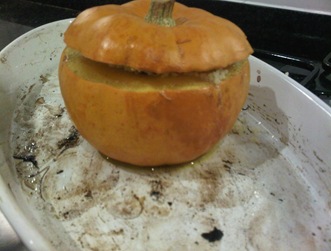
I did something a bit spooky last Saturday, at lunch at the Anchor and Hope. It had nothing to do with the smoked cod’s roe or the crumbed pressed pig’s head we chose to start (though these were pretty bold and out of character for me). No. It was the fact that, for the first time ever, I opted for the vegetal main course option. Of course, I have had many vegetable-heavy dishes at restaurants in my time, but these usually star a starch of some kind: a pasta or grain, a potato, or perhaps eggs. But vegetables only? Not usually. I had the baked baby pumpkin, a couple of them in fact, oozy with cheese and chestnuts with peppery leaves and a pickled walnut on the side. And they were delicious.

I am no stranger to a pure-veg plateful at home; a ratatouille or a bowl of steaming peas or cabbage is just the job some lunchtimes. But from a restaurant menu? Usually - and rather unimaginatively – something with a little more…erm, meat to it wins the day. Especially in an old-school *gastropub* like this one (only took us a decade or so to finally get there), which always make me think of chops and burgers. After such a great start, I will certainly be ordering more vegetables in the future.

It is timely that a newly svelte (alright, svelt-er) Hugh Fearnley-Wotsisname has sworn a meat embargo on his latest programme and I am enjoying the recipes very much. So, with this meat-free plateful fresh in my memory I wanted to recreate some pumpkin magic at home last week, whilst the BSG was away. I decided to try and emulate this kind of cosy-October-wonderfulness by trying a stuffed, baked munchkin pumpkin for last night’s supper.

Having had rice in a kedgeree that morning, I was keen for something different to make up the bulk of the stuffing, so opted for couscous, but I do think with hindsight that something with a little more bite and nuttiness would have stood up far better: some wild rice or barley, perhaps.

IMG00427-20111023-1905

To stir through the grains I had roasted some onions and red pepper until their extremities were pleasingly caramelised. To these I added some Shwarma spices from our local food haven, Lebanon Gate, which would permeate throughout and fill the house with wafts of warm, festive scents. Again, with the benefit of the experience I would have gone much heavier on these spices, perhaps adding some chilli for kicks, as well as stock for added depth. And cheese - a halloumi or mozzarella perhaps - melted within would have set this particular combo off nicely…

The part of this magic spell that did work first time was the baking; once you’ve nailed this, the possibilities are endless.

After washing and drying it, I carefully sliced the ‘lid’ off the baby munchkin, scooping out the string and seeds (TIP: discard the pith but keep and dry the seeds – they make a great snack when roasted). I then oiled and seasoned the inside of the fruit, replaced the lid and baked it in a shallow dish at 200 degrees for half an hour. During this time, I prepared the filling, mixing the grains, veg and spices together. I removed the pumpkin from the oven, filled it with the stuffing, replaced its lid and baked it for another 20 minutes.

Maybe it’s rather cheeky of me to post a largely imperfect recipe plus a few tweaks and call it worthwhile. However I am acutely aware that these orange orbs will be going very cheap from tomorrow morning, once Halloween has howled itself out, so there’ll be plenty of them around to experiment on. Perhaps I’ll try some kind of stew, or a pumpkin-based daal inside them next time; whichever proves the perfect magic spell, the experience has served as a satisfying display of the versatility of the fruit: a reminder that pumpkins can be a stars of the plate and not just scary Halloween lanterns or impromptu princess transport.

IMG00425-20111023-1826

Wednesday, 12 October 2011

Something new, every day…

On Saturday I found out that my grandpa doesn’t like cheese.

Oh, he will have it in a cooked form, say, cauliflower cheese and suchlike, but cheese for cheese’s sake, on a board, say, with crackers? No thank you (or thank yoohooo, as he’d say).

I’m not sure what’s more of a surprise: the aversion itself or the fact that it has only taken me thirty-odd years to learn about it.

I know quite a lot about his eating habits, you see, having spent a great deal of my childhood with him. There was always a rush between us four siblings to be the first at breakfast so we’d get the hallowed top of the milk (when it still came in bottles from a smiling man in a float) in the crater he made in our Alpen (always Alpen, decanted into Grandpa’s special plastic container to keep it fresh). Morning after morning he’d pretend to fall for the rubber fried egg we’d plant on the kitchen floor, tirelessly feigning surprise when we picked it up with our fingers. Next to him would be his own small brown teapot, he and Gran would always drink different tea.

Grandpa has always carved the roast on Sundays – nobody else can get roast beef so thin. We’d all watch as his fork would hover back and forth over his plate during the meal, as he made sure he’d speared a bit from every part of it before taking a mouthful – the perfect mouthful. And I am pretty sure that he is the reason that the chocolate digestive - nay, the pudding - was invented.

On Saturday my nephew, George, entered the world. He is wonderful beyond words.

george
George has a few months yet before the wider universe of food begins to cross his tiny taste-buds, but what adventures await him! I hope to be along for the ride. If he’s anything like his dad he’ll have a penchant for apples (and his two middle fingers), his mum he’ll be a great cook and a mayonnaise fiend, but who knows what his dislikes will be.

The BSG tells me that babies screw up their faces at sour things as they have an inbuilt anti-poison reflex, so perhaps lemons are out for the foreseeable. I wonder when he’ll try his first bread and Marmite and if he’ll like it *fingers firmly crossed on that one*.

Perhaps he’ll be an early gourmet, like G, who as a toddler was reaching for the olives (stoneless of course). Or like Lucy who dislikes bananas and tea (not together). Who knows what will influence his tastes – or even whether they are already established; will have Grandpa’s cheeseboard-phobia? We’ll just have to wait and see.

Whilst we wait, the BSG and I are rolling out a sort of meals-on-wheels service to his parents, to get them through the days that punctuate the sleep-deprived nights.

This is the first instalment; the recipe’s grabbed from Allegra McEvedy as I am hopeless with quantities and would no doubt lead you astray with the BSG-version.

Chicken, chorizo and butterbean stew
Serves 4 (or two good suppers for the freezer)

4 chicken legs, jointed into thighs and drumsticks
2 tbsp extra virgin olive oil
250g raw chorizo sausages, thickly sliced
2 red onions, roughly chopped
2 pepper, (green or red), cut into 2cm pieces
Pinches dried oregano
Pinches dried red chilli flakes
Whole dried chillies, (optional)
120 ml white wine
2 bay leaves
2 tbsp sherry vinegar
1 x 400g can chopped plum tomatoes
1 x 400g can butter beans
500 ml chicken stock
2 oranges, grated zest only
Crusty bread, to serve

Generously season the skin of the chicken pieces with sea salt. Heat the olive oil in a large deep frying pan over a high heat and fry chicken, skin-side down for 7 minutes, until the skin is a deep golden-brown.
Season the side of the chicken facing up in the pan, turn the chicken over and fry for a further 3 minutes, or until the flesh-side is lightly golden.

Remove the chicken from the pan and set aside. Add the chorizo slices to the pan and fry on a high heat. Once the chorizo begins to release its oil, add the onion, peppers, oregano and chilli and stir well. Place a lid on the pan and leave to cook for 5–10 minutes, or until the vegetables have begun to soften.

Stir in the wine, bay leaves and sherry vinegar and bubble the mixture for 2-3 minutes, or until the volume of the liquid begins to reduce. Add the tomatoes and beans, then top up with enough chicken stock to fill the pan three quarters full and bring to a simmer.

Put the chicken back in the pan so that the flesh is in the sauce but the skin is exposed. Sprinkle over the orange zest. Bring the mixture back to the boil, then reduce the heat so the stew is gently bubbling. Simmer for 40 minutes, until the chicken is cooked all the way through and the sauce has thickened a little.

Leave the stew to rest for 15 minutes before serving with crusty bread. The stew can be made a day in advance to allow the flavours to develop.

Friday, 30 September 2011

Kedgeree (and other breakfasts.)

I never tire of food-related fantasy games. Forget 'I Spy', how about ‘your last meal on earth’, or ‘if you had to eat one meal every meal for the rest of your life, what would it be?’ Well, that second one’s easy: breakfast.
I suppose I might’ve mentioned my inability to make a decision – or perhaps I haven’t. It drives the BSG round the bend; he is decision incarnate. But this one is easy. Breakfast is a meal where anything goes, thereby removing the choice conundrum from the proceedings. Thus, breakfast is perfect for someone like me.
pancakesAs well as blurry boundaries between foodstuffs - do I plump for yoghurt, fruit or Bircher muesli, croissants or the full English? - start and end times are also a grey area, meaning that it’s quite possible to graze from waking until lunchtime. Some of my happiest and most enduring university memories are from mornings whiled away in my friend Caz’s room in halls, drinking tea and eating toast and boiled eggs, more with Marmite and perhaps just one more piece - with marmalade - until lunchtime. We may have even missed a lecture (once), waiting for the perfect runny consistency to the yolk. Nothing cements firm friendship like sharing rounds of hot-buttered toast and pots of tea.
Of course, due to obvious time constraints, weekday breakfasts are more confined to the bounds of convenience; toast and its infinite possibilities, your favourite cereal, some porridge and stewed fruit once autumn takes its crisp hold. Eggs and bacon are reserved for the week’s end - a Friday treat of a bacon and marmalade sandwich, perhaps. The BSG and I rejoice in the advent of most weekends with a proper, frothy latte from our coffee machine – smileworthy, even on the dankest of days.
speckled eggsBreakfast is a parade of wonders, where friends’ wacky combinations are frequently exposed; Caz, for example, likes marmalade and Marmite on her toast… My Belgian great-grandmother loved nothing more than to dip toast and Gouda into her morning coffee (white and strong, if you’re interested). I am ever so pleased she passed me this habit. Try it - delicious. My grandpa, the king of the avant-garde food combo, always ate his sausages with marmalade, the Tabasco and Gentleman’s Relish never far out of his reach.
Then you have breakfasts that are ideal for certain situations. This year has been full of weddings, and I don’t think that there’s a better way to start a wedding Saturday than with kedgeree. Protein- and carb- rich, it stops the gap that the skipped proper lunch will leave, lines the stomach for the inevitable afternoon drinking and wakes up the taste buds with hints of spice, lemon and parsley – just make sure you check your teeth for green bits before you leave. Definitely worth prepping in advance, it can sit and wait, warming through under foil in the oven whilst you get on with things. Deal with any fishy/oniony bits before washing and dressing in your finery – no one likes eau-de-cuisine.
You don’t need a wedding as an excuse to whip this up. I reckon it’d steel you for any big (or small) day. It might take the edge off a marathon spring clean, a looming hulk of admin or a trip to a blue-and-yellow hångår to buy silly-named flat-pack furniture, a Venus flytrap and other stuff you never knew you needed.
Kedgeree
Serves 4
4 eggs, almost hard boiled (prob 6 minutes will do) and peeled
680g smoked haddock fillets (or a mixture of smoked and unsmoked fish works too. Try mackerel.)
2 bay leaves
250g basmati rice
115g butter
1 medium onion, finely chopped
2.5 teaspoonfuls mild curry powder
Juice of half a lemon (and the other half in wedges for squeezing over)
2 good handfuls of chopped flat-leaf parsley or coriander
In a large shallow pan, heat some water (or milk) - deep enough to submerge the fish - with the bay leaves. Add the fillets, bring to the boil and simmer gently for about 5-7 minutes, until the fish is cooked. Remove the fish from the pan and, when cool enough to handle, remove the skin, flake into chunks and set aside.
Cook the rice in boiling water according to pack instructions – it should be on the al-dente side. Drain the rice, refreshing briefly under a stream of hot water from the kettle. Return the steaming rice to the saucepan, covering it with a clean tea-towel and then the lid to stand for a few minutes. This is a top-quality tip from my step-mum and it ensures the fluffiest rice imaginable.
Whilst the rice is cooking, melt the butter in a pan over a low heat, then add the onions and soften them gently without colouring for five minutes or so. Add the curry powder and cook for another couple of minutes, until the kitchen is filled with aromas. Add the rice to the pan and heat gently through, carefully folding in the flaked fish and adding the lemon juice to taste. This can now stand in a pan or dish, waiting warm under foil in a low oven until you are ready to eat.
Just before serving, add the parsley or coriander, seasoning to taste with salt and pepper. Top with the eggs cut into quarters. Serve with the lemon wedges.
Twist: For some extra texture, crispy fried onion bits are often sprinkled on the top.

Monday, 12 September 2011

When the chips are down

Once when I was having a very bad day, a good friend of mine told me that a slice of watermelon would make things alright – turns out that’s what he’d had to hand at the time, but it worked in all its sunshiny redness. Not long later and from this same, wise source, it was a crunchy peanut butter and raspberry jam sandwich (the details here have to be very precise). Food had done at those moments what kind words could not.

On both occasions, it was as if having such a simple treat shone a different light on everything else and gave me strength to regroup. Now, I’m not advocating comfort eating – we all know what trouble that gets people into - but I reckon its true that, when the occasion demands it, a little of something you love does you good. A teaspoon of sugar in your builder’s when you need some galvanising? Sure. A bacon sandwich on a bleary morning, or a hot chocolate grabbed after a crappy journey to work? Definitely.

Last night’s supper was a case in point; the BSG roasted half a chicken rubbed in some Australian Bush Mix (we’d in the cupboard and had been wondering what to do with) until its skin was smoky and crisp, which we shared with some homemade coleslaw (carrot, sweetheart cabbage and red onion shredded in the Magimix and dressed in yoghurt, pepper and lemon) and some wonderful, golden McCain crispy French fries*.

Really, truly, happy-making food. Thank you, darling BSG.

*I am sure that nothing beats making your own, but in the absence of a deep fat fryer for multiple cooking sessions, these frozen chips are brilliant.

Sunday, 4 September 2011

Say it with flour

There are post-holiday blues, and then there are post holiday-blues, like when you return from your fairytale wedding on an island in a sparkly sea surrounded by your friends and family to find that the decorators you’ve so carefully timed to give your flat a refresh in your absence have disconnected your telly, left the contents of your kitchen on the floor, the books off the bookshelf and hung your pictures ‘their way’. Plus your beloved, tiny sausage dog is so cross at being left behind that he’s up at 3am wanting a pee and a walk –except he doesn’t really, he just wants to annoy you.

P1090278 How to combat such a comedown and persuade the newlyweds not to make a break for the nearest airport? Yesterday, September tried an effort at an Indian summer to show that London is still a brilliant place to be. I think it should keep trying – the BSG and I are taking them for drinks outside the Dock Kitchen next week.

In our first modest effort to go some way to buoying the spirits of these two dear friends – let’s call them Barbie and Ken – and thanking them for the Montenegrin extravaganza that was their wedding we decided to make them a quiche. I’d been meaning to make one, having never attempted it due to an abject fear of short pastry, and we’d been inspired by a very good homemade one recently courtesy of our friend G. Barbie happens to be a veggie, so it would also prove a useful exercise in the expansion of my pitiful repertoire in that department (stuffed baked marrow, anyone?).

I came across this recipe whilst flicking through the BSG’s newest epicurean tome, How to Eat In, by Adam Byatt of Trinity in Clapham. Both of us were already eager to visit Trinity; having read these recipes we’re champing at the bit. His recipe called for fresh morels, but it being early autumn rather than early summer we used dried chanterelles instead and it worked out fine.


Quiche of morels, broad beans and goat’s cheese

150g fresh morels (or 15g dried morels or chanterelles)

200g fresh broad beans (we used frozen ones)

1 bunch chives

Shortcrust pastry (make your own or readymade is fine)

4 eggs

2 egg yolks

700 ml double cream

100g goat’s cheese

Salt and pepper

Olive oil

Preheat the oven to 180 ˚C. Clean and trim the fresh mushrooms, or soak the dried ones. Blanch the beans in boiling salted water, run under cold water and pop them from their outer casings. Finely chop the chives.

Place a 26cm x 4cm tart ring or dish on a cold baking sheet.

Roll out the pastry on a floured surface to a 40cm disc that is 0.5 cm thick. Drape it over the tart ring, then press it well into the bottom inside edge and let it overhang the top. Line the pastry case with clingfilm and fill with rice or baking beans. Bake ‘blind’ for 25 minutes.

P1090476

Take the pastry case out of the oven, keeping it in the ring on the baking sheet. Removed the clingfilm and rice or beans and leave the pastry to cool. Turn the oven temperature down to 160˚C for cooking the quiche.

P1090475

Put the eggs and egg yolks into a large bowl and gently whisk in the cream. Crumble in the goat’s cheese, stir in the chives and season with salt and pepper.

Heat a frying pan, splash in some olive oil and gently fry the mushrooms for 4 minutes with plenty of seasoning. Remove and leave to cool, then add to the egg and cream mix with the beans. Leave to stand for 30 minutes – this will prevent the mushrooms from rising to the top of the filling during baking.

Trim the overhanging pastry off the cooled pastry case and brush away the crumbs to leave a perfectly lined tart ring.

Return the tart ring to the oven and, keeping the oven door open, pour the filling mix into the pastry case. Close the oven door and bake the quiche for 45 minutes, gently shaking the baking sheet after 30 minutes. When the quiche is done, the filling should be set around the edges with a slight wobble in the centre.

Take the quiche out of the oven and allow to cool in the tart ring for an hour or so before cutting into slices.

P1090485

Thursday, 18 August 2011

Pizza East Portobello

There are some things that sound like somebody, somewhere along the line, has made a mistake – but which just work. Take, for example, the wonderful marriages of salted butter and jam, celery with peanut butter and half an avocado with Worcester sauce.

My art teacher at school used to call such serendipitous discoveries ‘happy accidents’ – a bit like the summer afternoon when my gran and a ten-year-old me concocted a ‘pioneering’ drink from raspberry cordial and lemonade which we called the Frisbee and got terrifically excited about it. Only later did we find out that the raspberry cordial was actually Crème de Framboise and our terrific excitement was in fact drunkenness. Boy, that was one heck of an afternoon – thanks Gran.

IMG00364-20110716-1937

I digress. Just down the road from us, Pizza East has landed on the corner of Portobello and Golborne Road, W(est) 10; one such ‘happy accident’. No-one tell them it’s not East London and perhaps they won’t notice and try to take it back.

Although the place is only a few months old, the BSG and I have already managed to cover a large swathe of the menu and haven’t yet found a bum note. Though it is perennially packed out from 6.45pm, tables are swiftly turned, giving enough time to wet your whistle at the bar or outside on sunny evenings with a cocktail or some such (anywhere that serves Aperol spritzers is legendary in my book).

The place is open-plan so you can watch the drama unfold in the heat of the kitchen as wood-fired ovens roar open-mouthed and orders are relayed. Due to the presence of these ovens, the place also turns out other delicious things cooked amongst the flames. You can have crispy pork belly, beef fillet, salmon amongst others and if you can’t make up your mind, they do a pizza with pork belly on top. Heroes.

squid with salsa verde

To start, there are the usual Italian offerings of antipasti and others, but punctuated with a bit of Brit – bruschetta with bone marrow or beaten Pollock and radishes anyone? (We thought it rather a nice nod to the site’s previous guise, The Fat Badger pub). We shared the char-grilled squid with salsa verde and lemon – a nice clean start to proceedings. But we’ll probably try them all, before long.

Hands down the best pizza I have had in a long time was the spicy sausage, broccoli and mozzarella I had last time I was there. Just the right mix of pepper and richness, and amazingly no tomato sauce – the BSG had serious food envy, despite hugely enjoying his pizza with veal meatballs, prosciutto, cream and sage. My friend Dani, a veggie, adores the courgette flower, ricotta and marjoram, which sounds so pretty and is just as delicious. The ciabatta-style dough they use is pillowy and elastic, with a satisfying crunch where the crust bubbles up: an altogether different pizza dough, so the BSG thinks.

With the best will in the world, there is not usually room for pudding, so when we do squeeze it in we share. The raspberry sponge with mascarpone we had last time was well worth it, light and sharp and like a nursery teatime. No doubt we’ll try everything all over the coming months; it’s only fair to our support our new local which we’ve taken to our hearts (stomachs) – even if it doesn’t really sound that local. Moreover, there’s no doubt it will open more people eyes to the many wonders of the Golborne Road and its diverse shops and stalls. About time.

Monday, 27 June 2011

No green fingers

I’m not sure what’s become of my courgette plant. On Saturday when I last looked, it was standing strong, leaves aloft with a few signs of baby shoots and flowers – the promise of fruit – and today it is a twisted heap of limp, lying listless on the ground. To make matters worse, when I googled the problem, I was reminded that courgettes are ‘surprisingly easy to grow’…..grrrr.

I’m not sure if it was the cats or the slimers this time, but there are no dead slugs or snails in my carefully laid beer-trap (no, I’m not sorry, RSCPA,) and I’ve nothing equivalent for feline entrapment, so I guess I’ll have to lump it. One thing’s for sure: next year it’s going to be flowers, all the way – oh, and herbs seem to be ok. Vegetables just don’t seem to be my bag, and I haven’t got the energy for a Boggis/Bunce/Bean-style campaign against the plethora of pests on my block. Moreover, my potatoes are so tall they look like tomatoes (as has been pointed out several times); they resemble a healthy, leafy hedge, but alas, there are no goodies beneath.

A shame then, that I won’t have the glut of free courgettes I dreamt of as an excuse to make my new favourite thing, from Skye Gyngell’s How I Cook. We had this jammy marvel alongside a chilli-infused lamb shoulder and our green-fingered friend Joe’s new potatoes, freshly dug from his garden. They were so fresh they were crisp, like apples. I think I’ll leave the clever stuff to him.

Slow-cooked courgettes with mint

Serves 4-6

1 kg courgettes, trimmed

1 tbsp unsalted butter

2 tbsp extra virgin olive oil

3 garlic cloves, peeled and very finely chopped

1 dried red chilli

Sea salt

Handful of mint leaves, very finely chopped

Slice the courgettes into fine rounds (food processor slicer was practically invented for this). Put the butter and oil into a heavy-based saucepan and heat gently until the butter melts. Add the garlic and crumble in the chilli, stir once or twice, then cook for a few minutes until the garlic is soft, but not coloured.

Now add the courgettes with a good pinch of salt and put the lid on the pan. Cook over a low heat for 40 mins, stirring regularly to ensure that the courgettes do not stick to the bottom of the pan. Once cooked they should be very soft, almost fallen apart.

Stir in the chopped mint and serve warm.

IMG_2250

Wednesday, 27 April 2011

Borrowed and blue (well, green, actually)

If you, like my friend Antonia, happened to be jogging in St James’s Park early this morning you might have been party to the dress rehearsal, amongst the barriers, big screens and bunting. The city has been combed polished and planted to its best for the biggest day of pageantry in decades. If you’re not sure what I am talking about, do switch off and crawl back under that republican stronghold that is your rock.

IMG_2175

I have a bit of an excited feeling in my stomach, even though come Friday I am going to be hundreds of miles from the big smoke, trying to watch the coverage in a tabac in Normandy with a ‘staunch monarchist’ named Colette; we will both be wearing our hats. Although the BSG isn’t fussed and is much more interested in the outcome of the football season and in this evening’s Masterchef final, I am sure he will peek in at some point to have a look…

After last weekend, the weather’s looking dodgy. But, like birds dropping their wares on your head, rain on the wedding day is likely to bring good fortune (well somebody had to present an upside.) I am sure that William and Kate’s giant street-party/bbq will still go ahead unhindered, the two Dads manning the coals. I reckon it’ll be that old favourite, butterflied leg of lamb, rubbed in salt and sumac, and I’ve borrowed Yotam Ottolenghi’s recipe from Saturday’s Guardian to go with it. The BSG, his mum and I had it last night with our lamb chops and it was flavour fit for a princess. Call it our dress rehearsal.

Lamb cutlets with sumac, aubergine and green tahini

Serves four.

4 medium aubergines

2 tsp white-wine vinegar

2 tbsp olive oil

2 tsp dried mint

1 tsp ground cumin (can make it without this)

Salt and black pepper

For the lamb

2 600g racks of lamb, French trimmed

2 tbsp olive oil

5 tbsp sumac mixed with 2 tsp Maldon sea salt

4 tbsp Greek yoghurt

For the tahini sauce

60g tahini paste

1 mild green chilli, deseeded (or less, to taste)

40g parsley, leaves and stems

2 tbsp lemon juice

1 garlic clove

60ml water

1 pinch each salt and sugar

Pierce the aubergines in a few places with a knife, then lay on a foil-lined tray and place under a hot grill for up to an hour, turning them a few times. They need to deflate completely and the skin burn and break. Once done, remove from the grill. Set the oven to 220C/425F/gas mark 7. Cut down the centre of each aubergine and scoop the flesh into a colander. Leave to drain for at least 15 minutes. Chop up the aubergine, add the vinegar, oil, mint, cumin and plenty of salt and pepper, and set aside.

While the aubergines are cooking, start on the lamb. Put a large nonstick frying pan over high heat. Brush the lamb with oil and sear until golden-brown all over. Place on a baking sheet and press sumac and salt all over the flesh. Roast for 15-20 minutes, until cooked but still pink, then leave to rest for five minutes.

Put all the sauce ingredients in a small food processor bowl and work for two to three minutes, until you have a smooth, green paste. Add a little water, if needed, to get it to a pouring consistency.

To serve, carve the racks into individual cutlets and divide between four plates. Spoon over some of the aubergine, followed by some sauce, and top with a dollop of yoghurt.

IMG_2140