
Monday, 31 October 2011

Stuffed baked baby pumpkins

I did something a bit spooky last Saturday, at lunch at the Anchor and Hope. It had nothing to do with the smoked cod’s roe or the crumbed pressed pig’s head we chose to start (though these were pretty bold and out of character for me). No. It was the fact that, for the first time ever, I opted for the vegetal main course option. Of course, I have had many vegetable-heavy dishes at restaurants in my time, but these usually star a starch of some kind: a pasta or grain, a potato, or perhaps eggs. But vegetables only? Not usually. I had the baked baby pumpkin, a couple of them in fact, oozy with cheese and chestnuts with peppery leaves and a pickled walnut on the side. And they were delicious.

I am no stranger to a pure-veg plateful at home; a ratatouille or a bowl of steaming peas or cabbage is just the job some lunchtimes. But from a restaurant menu? Usually - and rather unimaginatively – something with a little more…erm, meat to it wins the day. Especially in an old-school *gastropub* like this one (only took us a decade or so to finally get there), which always make me think of chops and burgers. After such a great start, I will certainly be ordering more vegetables in the future.

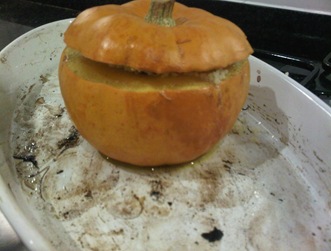
It is timely that a newly svelte (alright, svelt-er) Hugh Fearnley-Wotsisname has sworn a meat embargo on his latest programme and I am enjoying the recipes very much. So, with this meat-free plateful fresh in my memory I wanted to recreate some pumpkin magic at home last week, whilst the BSG was away. I decided to try and emulate this kind of cosy-October-wonderfulness by trying a stuffed, baked munchkin pumpkin for last night’s supper.

Having had rice in a kedgeree that morning, I was keen for something different to make up the bulk of the stuffing, so opted for couscous, but I do think with hindsight that something with a little more bite and nuttiness would have stood up far better: some wild rice or barley, perhaps.
IMG00427-20111023-1905

To stir through the grains I had roasted some onions and red pepper until their extremities were pleasingly caramelised. To these I added some Shwarma spices from our local food haven, Lebanon Gate, which would permeate throughout and fill the house with wafts of warm, festive scents. Again, with the benefit of the experience I would have gone much heavier on these spices, perhaps adding some chilli for kicks, as well as stock for added depth. And cheese - a halloumi or mozzarella perhaps - melted within would have set this particular combo off nicely…

The part of this magic spell that did work first time was the baking; once you’ve nailed this, the possibilities are endless.

After washing and drying it, I carefully sliced the ‘lid’ off the baby munchkin, scooping out the string and seeds (TIP: discard the pith but keep and dry the seeds – they make a great snack when roasted). I then oiled and seasoned the inside of the fruit, replaced the lid and baked it in a shallow dish at 200 degrees for half an hour. During this time, I prepared the filling, mixing the grains, veg and spices together. I removed the pumpkin from the oven, filled it with the stuffing, replaced its lid and baked it for another 20 minutes.

Maybe it’s rather cheeky of me to post a largely imperfect recipe plus a few tweaks and call it worthwhile. However I am acutely aware that these orange orbs will be going very cheap from tomorrow morning, once Halloween has howled itself out, so there’ll be plenty of them around to experiment on. Perhaps I’ll try some kind of stew, or a pumpkin-based daal inside them next time; whichever proves the perfect magic spell, the experience has served as a satisfying display of the versatility of the fruit: a reminder that pumpkins can be a stars of the plate and not just scary Halloween lanterns or impromptu princess transport.

IMG00425-20111023-1826

Wednesday, 12 October 2011

Something new, every day…

On Saturday I found out that my grandpa doesn’t like cheese.

Oh, he will have it in a cooked form, say, cauliflower cheese and suchlike, but cheese for cheese’s sake, on a board, say, with crackers? No thank you (or thank yoohooo, as he’d say).

I’m not sure what’s more of a surprise: the aversion itself or the fact that it has only taken me thirty-odd years to learn about it.

I know quite a lot about his eating habits, you see, having spent a great deal of my childhood with him. There was always a rush between us four siblings to be the first at breakfast so we’d get the hallowed top of the milk (when it still came in bottles from a smiling man in a float) in the crater he made in our Alpen (always Alpen, decanted into Grandpa’s special plastic container to keep it fresh). Morning after morning he’d pretend to fall for the rubber fried egg we’d plant on the kitchen floor, tirelessly feigning surprise when we picked it up with our fingers. Next to him would be his own small brown teapot, he and Gran would always drink different tea.

Grandpa has always carved the roast on Sundays – nobody else can get roast beef so thin. We’d all watch as his fork would hover back and forth over his plate during the meal, as he made sure he’d speared a bit from every part of it before taking a mouthful – the perfect mouthful. And I am pretty sure that he is the reason that the chocolate digestive - nay, the pudding - was invented.

On Saturday my nephew, George, entered the world. He is wonderful beyond words.

george
George has a few months yet before the wider universe of food begins to cross his tiny taste-buds, but what adventures await him! I hope to be along for the ride. If he’s anything like his dad he’ll have a penchant for apples (and his two middle fingers), his mum he’ll be a great cook and a mayonnaise fiend, but who knows what his dislikes will be.

The BSG tells me that babies screw up their faces at sour things as they have an inbuilt anti-poison reflex, so perhaps lemons are out for the foreseeable. I wonder when he’ll try his first bread and Marmite and if he’ll like it *fingers firmly crossed on that one*.

Perhaps he’ll be an early gourmet, like G, who as a toddler was reaching for the olives (stoneless of course). Or like Lucy who dislikes bananas and tea (not together). Who knows what will influence his tastes – or even whether they are already established; will have Grandpa’s cheeseboard-phobia? We’ll just have to wait and see.

Whilst we wait, the BSG and I are rolling out a sort of meals-on-wheels service to his parents, to get them through the days that punctuate the sleep-deprived nights.

This is the first instalment; the recipe’s grabbed from Allegra McEvedy as I am hopeless with quantities and would no doubt lead you astray with the BSG-version.

Chicken, chorizo and butterbean stew
Serves 4 (or two good suppers for the freezer)

4 chicken legs, jointed into thighs and drumsticks
2 tbsp extra virgin olive oil
250g raw chorizo sausages, thickly sliced
2 red onions, roughly chopped
2 pepper, (green or red), cut into 2cm pieces
Pinches dried oregano
Pinches dried red chilli flakes
Whole dried chillies, (optional)
120 ml white wine
2 bay leaves
2 tbsp sherry vinegar
1 x 400g can chopped plum tomatoes
1 x 400g can butter beans
500 ml chicken stock
2 oranges, grated zest only
Crusty bread, to serve

Generously season the skin of the chicken pieces with sea salt. Heat the olive oil in a large deep frying pan over a high heat and fry chicken, skin-side down for 7 minutes, until the skin is a deep golden-brown.
Season the side of the chicken facing up in the pan, turn the chicken over and fry for a further 3 minutes, or until the flesh-side is lightly golden.

Remove the chicken from the pan and set aside. Add the chorizo slices to the pan and fry on a high heat. Once the chorizo begins to release its oil, add the onion, peppers, oregano and chilli and stir well. Place a lid on the pan and leave to cook for 5–10 minutes, or until the vegetables have begun to soften.

Stir in the wine, bay leaves and sherry vinegar and bubble the mixture for 2-3 minutes, or until the volume of the liquid begins to reduce. Add the tomatoes and beans, then top up with enough chicken stock to fill the pan three quarters full and bring to a simmer.

Put the chicken back in the pan so that the flesh is in the sauce but the skin is exposed. Sprinkle over the orange zest. Bring the mixture back to the boil, then reduce the heat so the stew is gently bubbling. Simmer for 40 minutes, until the chicken is cooked all the way through and the sauce has thickened a little.

Leave the stew to rest for 15 minutes before serving with crusty bread. The stew can be made a day in advance to allow the flavours to develop.

Friday, 30 September 2011

Kedgeree (and other breakfasts.)

I never tire of food-related fantasy games. Forget 'I Spy', how about ‘your last meal on earth’, or ‘if you had to eat one meal every meal for the rest of your life, what would it be?’ Well, that second one’s easy: breakfast.
I suppose I might’ve mentioned my inability to make a decision – or perhaps I haven’t. It drives the BSG round the bend; he is decision incarnate. But this one is easy. Breakfast is a meal where anything goes, thereby removing the choice conundrum from the proceedings. Thus, breakfast is perfect for someone like me.
pancakesAs well as blurry boundaries between foodstuffs - do I plump for yoghurt, fruit or Bircher muesli, croissants or the full English? - start and end times are also a grey area, meaning that it’s quite possible to graze from waking until lunchtime. Some of my happiest and most enduring university memories are from mornings whiled away in my friend Caz’s room in halls, drinking tea and eating toast and boiled eggs, more with Marmite and perhaps just one more piece - with marmalade - until lunchtime. We may have even missed a lecture (once), waiting for the perfect runny consistency to the yolk. Nothing cements firm friendship like sharing rounds of hot-buttered toast and pots of tea.
Of course, due to obvious time constraints, weekday breakfasts are more confined to the bounds of convenience; toast and its infinite possibilities, your favourite cereal, some porridge and stewed fruit once autumn takes its crisp hold. Eggs and bacon are reserved for the week’s end - a Friday treat of a bacon and marmalade sandwich, perhaps. The BSG and I rejoice in the advent of most weekends with a proper, frothy latte from our coffee machine – smileworthy, even on the dankest of days.
speckled eggsBreakfast is a parade of wonders, where friends’ wacky combinations are frequently exposed; Caz, for example, likes marmalade and Marmite on her toast… My Belgian great-grandmother loved nothing more than to dip toast and Gouda into her morning coffee (white and strong, if you’re interested). I am ever so pleased she passed me this habit. Try it - delicious. My grandpa, the king of the avant-garde food combo, always ate his sausages with marmalade, the Tabasco and Gentleman’s Relish never far out of his reach.
Then you have breakfasts that are ideal for certain situations. This year has been full of weddings, and I don’t think that there’s a better way to start a wedding Saturday than with kedgeree. Protein- and carb- rich, it stops the gap that the skipped proper lunch will leave, lines the stomach for the inevitable afternoon drinking and wakes up the taste buds with hints of spice, lemon and parsley – just make sure you check your teeth for green bits before you leave. Definitely worth prepping in advance, it can sit and wait, warming through under foil in the oven whilst you get on with things. Deal with any fishy/oniony bits before washing and dressing in your finery – no one likes eau-de-cuisine.
You don’t need a wedding as an excuse to whip this up. I reckon it’d steel you for any big (or small) day. It might take the edge off a marathon spring clean, a looming hulk of admin or a trip to a blue-and-yellow hångår to buy silly-named flat-pack furniture, a Venus flytrap and other stuff you never knew you needed.
Kedgeree
Serves 4
4 eggs, almost hard boiled (prob 6 minutes will do) and peeled
680g smoked haddock fillets (or a mixture of smoked and unsmoked fish works too. Try mackerel.)
2 bay leaves
250g basmati rice
115g butter
1 medium onion, finely chopped
2.5 teaspoonfuls mild curry powder
Juice of half a lemon (and the other half in wedges for squeezing over)
2 good handfuls of chopped flat-leaf parsley or coriander
In a large shallow pan, heat some water (or milk) - deep enough to submerge the fish - with the bay leaves. Add the fillets, bring to the boil and simmer gently for about 5-7 minutes, until the fish is cooked. Remove the fish from the pan and, when cool enough to handle, remove the skin, flake into chunks and set aside.
Cook the rice in boiling water according to pack instructions – it should be on the al-dente side. Drain the rice, refreshing briefly under a stream of hot water from the kettle. Return the steaming rice to the saucepan, covering it with a clean tea-towel and then the lid to stand for a few minutes. This is a top-quality tip from my step-mum and it ensures the fluffiest rice imaginable.
Whilst the rice is cooking, melt the butter in a pan over a low heat, then add the onions and soften them gently without colouring for five minutes or so. Add the curry powder and cook for another couple of minutes, until the kitchen is filled with aromas. Add the rice to the pan and heat gently through, carefully folding in the flaked fish and adding the lemon juice to taste. This can now stand in a pan or dish, waiting warm under foil in a low oven until you are ready to eat.
Just before serving, add the parsley or coriander, seasoning to taste with salt and pepper. Top with the eggs cut into quarters. Serve with the lemon wedges.
Twist: For some extra texture, crispy fried onion bits are often sprinkled on the top.